
Audi S8 D4: giving the 4.0 TFSI V8 its voice back, the complete guide
The right S8 D4 exhaust loosens the 4.0 TFSI twin-turbo V8 that the factory holds in check, without turning the large Audi saloon into a noisy car. The Rog exhaust, a cat-back with valves offered in 304 stainless steel or titanium, is made to your VIN, with the downpipes as an option. This guide presents the car, its engine and the configurations that suit it.
Your valved exhaust for Audi S8 D4 is configured from your VIN, and the Audi S8 D4 Valved Exhaust page brings together every system we make for this generation.
 Audi S8 D4 4.0 TFSI V8 Klapeli Egzoz Sistemi (2013-2018)Başlangıç fiyatı 2 360 € · free delivery · 20 working days
View

Your Rog exhaust for the Audi S8 D4 V8
Configure my exhaustThe short answer.
- For
- Audi S8 D4 with 520 hp, quattro saloon with the 4.0 TFSI twin-turbo V8
- Engine
- 4.0 l twin-turbo V8, 520 hp, 650 Nm from 1,700 rpm
- Exhaust
- Cat-back with valves, from the downpipes connection to the four outlets
- Sound
- Straight pipe for the raw rumble, or a rounder resonator
- Material
- 304 stainless steel, or brushed, gold or purple titanium
- Downpipes
- 200-cell or 100-cell downpipes, or catalyst-free, as an option
- Tips
- Chrome, gloss black, blued titanium, or no tips
- Lead time and warranty
- 20 working days of manufacturing, free delivery, 3-year warranty
Your vehicle.
All our exhausts for this generation, version by version, are brought together on one page: Audi S8 D4 Valved Exhaust.
The fourth-generation S8, type 4H, followed the V10 S8 by choosing a more economical twin-turbo V8. It remains an executive saloon of very measured character, built to cross Europe fast and quietly. Here is what you need to know about it before choosing an exhaust for it.
- Model
- Audi S8 D4 (type 4H), large sports saloon of the A8 range
- Years
- 2013 to 2018 on our product page; the car's launch dates back to 2012
- Engine
- 4.0 TFSI V8, 4.0 litres, direct injection, two turbos
- Power
- 520 hp (382 kW) at 6,000 rpm
- Torque
- 650 Nm, from 1,700 to 5,500 rpm
- Drivetrain
- quattro all-wheel drive, eight-speed Tiptronic automatic gearbox
- Performance
- 0 to 100 km/h in 4.2 seconds, limited to 250 km/h
- Neighbouring version
- The S8 plus, beyond 600 hp, remains outside this product page
A V8 that succeeds the V10
With the D4, Audi changes philosophy for its large sports saloon. The previous generation's naturally aspirated ten-cylinder gives way to a more compact, more economical and distinctly torquier twin-turbo eight-cylinder. The car gains in pick-up what it loses in revs, and the driver no longer needs to go looking for the revs to feel the push.
0 to 100 km/h falls to 4.2 seconds, even though the unladen weight exceeds 1,900 kg. The balance rests on the quattro all-wheel drive, which distributes power to the front as well as the rear, and on a chassis designed for long stages rather than for the track.
The 4.0 TFSI twin-turbo in detail
The engine, code CGTA, is a four-litre V8 with direct injection. Its two turbos are housed in the hollow of the V, between the banks of cylinders, a compact layout that shortens the path of the gases but traps a lot of heat under the bonnet.
It claims 520 hp at 6,000 rpm and a torque of 650 Nm available from 1,700 rpm, held up to 5,500 rpm. This very wide plateau explains the car's ease: it accelerates with the same authority at low revs as at the top of the rev counter.
Four cylinders at rest
This V8 can also spare fuel: a system called cylinder on demand shuts down four of the eight cylinders in many driving situations, when the load is low. Audi credits it with part of the drop in consumption announced when the model was launched.
For the driver, this means the engine changes voice depending on its load. On the motorway at a steady speed, it runs on half its cylinders and the sound becomes almost confidential; under firmer pressure on the accelerator, the whole thing wakes up.
Factory figures and tuning
This engine is reputed to tolerate a more generous map, because its architecture and its cooling are generously sized. The bars below compare the factory values with those obtained with a full ECU remap.
An exhaust alone brings mainly sound and a little weight saving; the power increase comes from the map, which benefits most from less restrictive downpipes.
Power
Torque
Stage 2: published figures with the downpipes and an ECU remap carried out by a tuner.
An eight-speed torque-converter gearbox
The S8 D4 gets an eight-speed Tiptronic automatic gearbox, of the torque-converter type, not a dual-clutch. It links the gears without a jolt, which serves comfort, and it allows low-rev driving over long distances, with a perfectly calm car.
The last gears, very long, keep the revs low when cruising, which benefits fuel consumption as much as the silence of the cabin.
The choice has a consequence for the acoustic behaviour: at a steady speed, the engine turns low, and it is in this zone that an exhaust is judged on drone. The management of the valves takes on its full meaning here.
Why the V8 murmurs
Between the turbos that naturally filter the pulsations of the gases, the silencers sized for cruising and the insulation of a top-rank limousine, everything works to hold the sound back. Inside, you mainly perceive a muffled breath.
It is not a flaw: it is the specification of an executive car, which you drive or travel in at the back while reading your messages. But there is still room for the driver to choose, at certain moments, to hear more of what the V8 can do.
The factory valves and the drive modes
The S8 D4 has valves in its factory exhaust: two motorised flaps, which the ECU opens or closes according to the drive mode chosen. The more dynamic the mode, the more the V8 is allowed to express itself.
The Rog product page offers two ways to operate them. With the Factory option, the exhaust arrives with the valve mounts, which your garage refits; the drive modes then keep control, as before. With the Rog option, the valves are fitted to the exhaust and operated by the remote.
The Rog remote
A small control unit goes in the boot; a two-button remote opens and closes the valves in one gesture. Open, they stay open; closed, they stay closed, whatever the drive mode.
This independence appeals to those who want a sound they choose rather than one imposed on them: you close before the motorway, you open on an empty back road. It is also worthwhile if you prefer not to depend on Audi's modes.
What the Rog exhaust changes
The exhaust replaces the rear part of the exhaust: centre section, silencers, valves and four round outlets. It removes the restrictions that hold the V8 back and releases a deep rumble at idle, a broad push and, on lift-off, sharp pops.
It is made to your VIN for the 520 hp saloon. It is fitted with clamps and gaskets, without welding or cutting, by your garage, in about two hours on a lift.
The optional downpipes
Between the turbos and the Rog exhaust, parts contain the catalytic converters: on this twin-turbo V8, these are the downpipes, one per turbo, offered as an option on the product page.
Three choices exist. The 200-cell keeps the emissions control and suits a saloon driven every day. The 100-cell gains in breath and voice, its acceptance depending on the vehicle and the country. The catalyst-free version gives the freest sound.
Stainless steel, titanium, straight pipe or resonator
304 stainless steel gives a full bass and good resistance to winter road salt. Titanium weighs around 40% less for the same design, with a brighter note in the revs, and comes in brushed, gold or purple.
For character, the straight pipe keeps the V8's roughness and the resonator rounds off the voice, without taking away the exhaust's sportiness. The price stays the same.
Tips and neighbouring S8s
The outlets are chosen in chrome, gloss black or blued titanium, or left aside with the no-tips option. The D5, which takes up the same V8 architecture, has its own product page, as does the V10 S8 of the previous generation.
Configure your exhaust.
How the exhaust is put together
On the S8 D4, the Rog exhaust starts at the downpipes connection, under the floor, and continues through the centre section, the silencers and the valves to the four outlets. The twin-turbo V8's catalysed downpipes are offered as an option on the product page.
Each choice explained in detail, from sound to material: How to configure your exhaust.
Your exhaust for the S8 D4
On the product page, you choose 304 stainless steel or titanium, the straight pipe or the resonator, the tips and, if you wish, the downpipes. The valves are operated with the factory control or the Rog remote.
The price of each configuration is shown on the product page, in your currency.
Your choices carry over to the product page: only the finishes, your VIN and the cart remain.
Three recommended configurations.
-
Executive S8
- 4.0 TFSI V8
- Stainless steel
- No downpipe
- Resonator
- Factory control
For the saloon used every day: factory downpipes, a voice rounded by the resonator and valves controlled by the drive modes.
View this configuration -
More expressive S8
- 4.0 TFSI V8
- Brushed titanium
- 200-cell downpipe
- Straight pipe
- Rog remote
For fine roads: lighter titanium, 200-cell downpipes that keep the emissions control and the V8's rumble through the straight pipe.
View this configuration -
Tuned S8
- 4.0 TFSI V8
- Gold titanium
- 100-cell downpipe
- Straight pipe
- Rog remote
For a saloon accompanied by an ECU remap: gold titanium, 100-cell downpipes and valves open on demand.
View this configuration
From order to fitting.
VIN, manufacture, delivery, fitting and warranty, step by step
Questions.
Can my S8 plus take this exhaust?
This line is designed for the 520 hp S8. The more powerful version is not automatically covered: send us your VIN and we will study the case before any purchase.
My S8 is from 2012: is it covered?
The product page states 2013 to 2018, whereas the car was launched in 2012. For a model year at the edge of that range, the VIN supplied with the order settles it before production.
Does an ECU remap transform this 520 hp V8?
The exhaust alone requires no remap. It is the downpipes combined with a suitable map that change the figures, shown as bars for the 520 hp version.
Does cylinder on demand change anything for the exhaust?
No: shutting down four cylinders is handled by the engine. The Rog exhaust is made to your VIN and adapts to the saloon's routing, whatever the V8's operating mode.
How does it sound compared with the factory S8 D4?
On our scale of 0 to 10, the factory exhaust sits at around 3. With the valves open, the Rog exhaust alone rises to 7, and the optional downpipes go further. With the valves closed, the saloon stays close to its original calm.
Straight pipe or resonator on a twin-turbo V8?
The straight pipe exposes the V8's rumble and pops. The resonator, at the same price, brings a rounder and slightly softer voice, often preferred for an executive saloon.
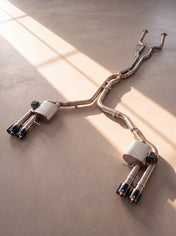
Audi S8 D4 4.0 TFSI V8 Klapeli Egzoz Sistemi (2013-2018)
Başlangıç fiyatı 2 360 € · 3-year warranty
Configure my exhaustA question about your S8 D4?
Put it to the Rog Advisor or write to us: we reply in writing, within 24 hours.
Further reading.
Sonraki okumalar
- Mercedes-AMG E55 W211 / S211 için hangi egzoz seçilmeli? Mercedes-Benz E 55 AMG W211 veya S211 station wagon: kompresörlü V8'e sahip bu E-Serisi için VIN numaranıza göre...
- Mercedes-AMG CLS53 C257: the return of the straight-six, the exhaust system guide A four-door coupé with flowing lines, the CLS53 C257 benefits from Mercedes' return to a layout the brand...
- Which exhaust to choose for the Toyota GR Supra A90 3.0 L6? The GR Supra A90 revived a legendary line by pairing a short rear-wheel-drive chassis with the B58 3.0-litre...