
Range Rover Sport SVR L494 exhaust: which one to choose?
The right SVR L494 exhaust lets the Range Rover Sport's supercharged V8 growl fully while keeping the SUV as calm as a Range Rover when needed. The Rog line is built for that: a 304 stainless steel or titanium cat-back with flaps, made to your VIN. This guide first describes the SVR and its engine, then the configurations we recommend.
Your valved exhaust for Land Rover Range Rover Sport SVR L494 V8 is configured from your VIN, and the Land Rover Valved Exhaust page brings together all our Land Rover systems.
 Land Rover Range Rover Sport SVR L494 V8 5.0 Klapeli Egzoz Sistemi (2019-2022)Başlangıç fiyatı 2 360 € · free delivery · 20 working days
View

Your Rog exhaust for the Land Rover Range Rover Sport SVR L494 V8
Configure my exhaustThe short answer.
- Vehicle
- Land Rover Range Rover Sport SVR, second generation L494, 575 hp V8
- Engine
- 5.0 litre supercharged V8
- Exhaust
- Valved cat-back, to the four tips
- Sound
- The V8's bass, with no added filter
- Material
- 304 stainless steel, or brushed, gold or purple titanium
- Catalytic converters
- Catalytic front section, 200 or 100 cells, or catalyst-free, as an option
- Valves
- From the SVR's own controls, or with the Rog remote
- Lead time and warranty
- 20 working days of manufacturing, free delivery, 3-year warranty
Your vehicle.
The SVR L494 is the most radical Range Rover Sport of its generation, prepared by Land Rover's Special Vehicle Operations division. It keeps the range's off-road abilities but aims first at the road and performance. Here is what you need to know before choosing a line for it.
- Model
- Land Rover Range Rover Sport SVR, type L494
- Years
- Launched in 2015; 575 hp version from the facelift of late 2017
- Engine
- 5.0 litre supercharged petrol V8
- Factory output
- 575 hp and 700 Nm (550 hp and 680 Nm before the facelift)
- Gearbox
- Eight-speed automatic
- Drivetrain
- Permanent four-wheel drive
- 0 to 100 km/h
- 4.5 s for the 575 hp version
- Factory exhaust
- Active, two-stage, with electronically controlled flaps and four outlets
Land Rover's first SVR
Land Rover presented the Range Rover Sport SVR in 2014, for sale in 2015. It was the first model of the brand to carry the SVR badge, the name reserved for the highest-performing versions from the Special Vehicle Operations division.
The SVR is based on the second-generation Range Rover Sport, type L494, produced from 2013 to 2022. Compared with the other versions, it gets bucket seats, more open bumpers for cooling, recalibrated suspension and steering, and reinforced braking.
An aluminium body
The second generation of the Range Rover Sport, which appeared in 2013, abandoned the first one's chassis for a self-supporting body entirely in aluminium, derived from that of the Range Rover L405. This choice made the SUV lose several hundred kilos and made it much more agile on the road.
It is on this lightened base that Special Vehicle Operations built the SVR. It remains a heavy vehicle, of the order of 2.3 tonnes, but its behaviour surprises for an SUV of this size, and its V8 gives it the performance of a sports saloon.
For the exhaust, this architecture means a long line, which runs under the floor to the rear bumper. The VIN of your SVR lets us make each section to the right dimensions.
The facelift: 575 hp and 700 Nm
At launch, the SVR developed 550 hp and 680 Nm. With the Range Rover Sport facelift presented in autumn 2017, power rose to 575 hp and torque to 700 Nm, for a quoted 0 to 100 km/h in 4.5 seconds.
The Rog product page targets this facelifted SVR. The bars below take unchanged the values of its product page. If your SVR dates from before the facelift, your VIN lets us check compatibility before any manufacture.
Power
Torque
Stage 2: published figures with the catalytic converters and an ECU remap carried out by a tuner.
The 5.0 supercharged V8
Under the bonnet, the SVR gets a five-litre petrol V8, fed by a mechanical supercharger driven by the crankshaft. The same engine, in similar tunes, also powers the Jaguar F-Type SVR and F-Pace SVR.
A supercharger does not have a turbo's response lag: the pressure arrives as soon as you touch the accelerator, and the thrust stays steady up to high revs. On an SUV of this weight, that is what gives the SVR its strong pulling power at every speed.
Eight speeds and four-wheel drive
The SVR sends its power through an eight-speed automatic gearbox, whose shifts firm up in Dynamic mode. The all-wheel drive is permanent.
The SVR keeps the range's air suspension and off-road aids: you can take it down a track, even though it is designed first for the road.
An active exhaust from the start
The SVR is the first Land Rover to have received an active two-stage exhaust, with electronically controlled flaps. In Dynamic mode, a button opens the flaps wide; the rest of the time, the car manages them according to load and revs.
This system already makes the SVR a vocal SUV, with a noticeable start and pops on the overrun. But with the flaps closed, and at a moderate pace, the factory line still holds back a large part of the V8's bass.
What the Rog line adds
With the flaps open, the Rog line gives the V8 a thicker and more continuous growl, from idle to the top of the rev counter, with the whine of the supercharger still audible in the background. The SVR gains presence from low revs, where the factory line stays well-behaved.
With the flaps closed, the SUV recovers the calm of a Range Rover for the motorway or the town. It is this range between the two positions that makes a line with flaps worthwhile on a vehicle of this nature. In the morning, leaving the house, the V8 stays in the background; on a clear road, it recovers all its presence with one gesture, without having to change driving mode.
Keep the SVR's controls or switch to the remote
As the SVR has factory flaps, the product page offers the Factory option: the line arrives with the provided mountings, your garage refits the flaps there, and the car keeps controlling them with its modes and its exhaust button.
The Rog option does the opposite: the flaps arrive fitted with a remote, and you decide. Open, they stay open; closed, they stay closed, whatever the mode selected on the Terrain Response.
Stainless steel or titanium
304 stainless steel suits an SUV that drives in all weathers, and it gives the V8 a full, deep sound. Titanium, about 40% lighter for an identical design, makes the note clearer and more metallic at high revs; it comes in brushed, gold or purple.
On a vehicle of more than two tonnes, the weight saving matters less than on a light sports car: it is above all the tone and the look that guide the choice. The purple of the titanium, for example, shows up well behind the SVR's dark bumpers.
Four outlets and Rog tips
The SVR exits through four tips, two on each side of the diffuser. The Rog line keeps this layout, and you choose Rog tips in chrome, gloss black or blued titanium, or a line without an added tip.
Gloss black goes with the Carbon trims and dark colours; chrome stays true to the Range Rover style; blued titanium gives a sportier touch to a light-coloured SVR.
The optional catalytic converters
Under the name "Manifold", the product page offers the V8's catalytic converters, located just after the manifolds. With 200 cells, the emissions control is kept; the 100-cell version depends on the car and the rules of the country; the catalyst-free version gives the freest sound.
Without a remap, this part acts on the sound and a little on the weight, not on the power. The values published on the product page assume the optional catalytic converters and a map made by a tuner. Rog makes the line to your VIN, and your garage fits it without welding or cutting.
Configure your exhaust.
How the exhaust is put together
On the Range Rover Sport SVR, the Rog line starts behind the V8's catalytic section and runs to the four outlets: pipes, silencers and flaps. The catalytic converters, just after the V8's manifolds, are offered as an option on the product page under the name "Manifold".
Each choice explained in detail, from sound to material: How to configure your exhaust.
Your line for the Range Rover Sport SVR L494
On the product page, you take 304 stainless steel or brushed, gold or purple titanium, and if you wish the catalytic converters, from the 200-cell to the catalyst-free version. The flaps stay on the SVR's controls or switch to the Rog remote, and the Rog tips in chrome, gloss black or blued titanium finish the line.
The price of each configuration is shown on the product page, in your currency.
Your choices carry over to the product page: only the finishes, your VIN and the cart remain.
Three recommended configurations.
-
Grand touring
- Stainless steel
- No manifold
- Factory valves
- Chrome tips
For an SVR that travels: the catalytic converters stay factory, the stainless steel takes the miles and the car keeps control of its flaps with the exhaust button.
View this configuration -
V8 up front
- Titanium
- 200-cell sports catalytic converter
- Rog remote
- Gloss black tips
For an SVR that has to be heard: 200-cell catalytic converters that keep the emissions control, titanium that sounds brighter at high revs, and the remote to open whatever the mode.
View this configuration -
Track
- Titanium
- Decat
- Rog remote
- Blued titanium tips
For an SVR taken on the track: catalyst-free version, flaps open from the first lap to the last and blued titanium tips.
View this configuration
From order to fitting.
VIN, manufacture, delivery, fitting and warranty, step by step
Questions.
Is my 550 hp SVR, from before the facelift, covered?
This line is designed for the facelifted 575 hp SVR. For a 2015 to 2017 SVR, send us your VIN: we check the line's compatibility and reply in writing before any manufacture.
Does the line suit a non-SVR Range Rover Sport V8?
No. The other V8 versions of the Range Rover Sport L494 do not have the same line or the same active exhaust. This line is made for the SVR.
Does the SVR's exhaust button still work with the Rog line?
Yes, with the Factory option: the line arrives with the mountings of the factory flaps, your garage refits them there, and the button and the driving modes keep their role. With the Rog option, the remote takes over.
What does it sound like compared with the factory line of the SVR L494?
The standard SVR is already vocal. On our scale of 0 to 10, the Rog line alone sits at 7 with the flaps open, with a more continuous bass, and the optional catalytic converters go further. With the flaps closed, the SUV stays close to its factory volume.
Why no resonator on this product page?
On the SVR, the line is offered in a single character, designed around the bass of the supercharged V8. The choice covers the material, the catalytic converters, the control of the flaps and the tips.
The Jaguar F-Pace SVR has the same V8: is the line common?
No. The engine is the same, but the body and the route of the line differ: the F-Pace SVR has its own product page and guide.
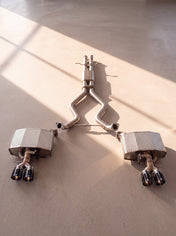
Land Rover Range Rover Sport SVR L494 V8 5.0 Klapeli Egzoz Sistemi (2019-2022)
Başlangıç fiyatı 2 360 € · 3-year warranty
Configure my exhaustA question about your Range Rover Sport SVR L494?
Put it to the Rog Advisor or write to us: we reply in writing, within 24 hours.
Further reading.
Sonraki okumalar
- Mercedes-AMG E55 W211 / S211 egzoz sistemi: hangisi seçilmeli? Mercedes-Benz E 55 AMG W211 veya S211 station wagon: kompresörlü V8'e sahip bu E-Serisi için VIN numaranıza göre...
- Mercedes-AMG CLS53 C257 exhaust: which one to choose? A four-door coupé with flowing lines, the CLS53 C257 benefits from Mercedes' return to a layout the brand...
- Toyota GR Supra A90 3.0 L6 exhaust: which one to choose? The GR Supra A90 revived a legendary line by pairing a short rear-wheel-drive chassis with the B58 3.0-litre...