
Guides Porsche Cayenne 955 / 957
Porsche Cayenne 955 / 957 exhaust: which one to choose?
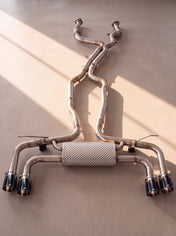
For a first-generation Porsche Cayenne, 955 or 957, the valved exhaust to choose is the one that gives the engine back the voice of a Porsche without taking away the family's calm everyday SUV. The Rog exhaust is a cat-back made from your VIN, which identifies your engine, in 304 stainless steel or titanium, with valves controlled by a remote. We begin with the car, its versions and its V8, then present three configurations chosen for it.
Your valved exhaust for Porsche Cayenne 955 / 957 is configured from your VIN, and the Porsche Valved Exhaust page brings together all our Porsche systems. Driving a Porsche Cayenne 958? See: Porsche Cayenne 958 valved exhaust.
 Porsche Cayenne 955 / 957 Klapeli Egzoz Sistemi (2002-2010)Başlangıç fiyatı 2 360 € · free delivery · 20 working days
View

Your Rog exhaust: Porsche Cayenne 955 / 957
Configure my exhaustThe short answer.
- Vehicles
- First-generation Porsche Cayenne, types 955 and 957, from 2002 to 2010; engine identified by VIN
- Product page reference
- Cayenne S 955, 4.5-litre naturally aspirated V8
- Exhaust
- Valved cat-back all the way to the tips
- Sound
- A single voice, designed for this engine
- Material
- 304 stainless steel or titanium, three possible shades
- Manifolds or downpipes
- Manifolds or downpipes depending on the engine, as an option
- Valves
- Fitted on the exhaust, with Rog remote
- Lead time and warranty
- Made in 20 working days, delivered to your door at no charge, 3-year warranty
Your vehicle.
The first-generation Cayenne brought Porsche into the world of SUVs, with two successive types and a wide range of engines. Before choosing an exhaust, you need to know which one is yours: that is what your VIN tells us, and what this chapter helps you understand.
- Types
- 955 from 2002 to 2006, then 957 after the 2007 update, until 2010
- Launch
- Paris Motor Show, September 2002
- Reference version of the product page
- Cayenne S 955: 4,511 cc naturally aspirated V8
- Factory output
- 340 hp at 6,000 rpm; 420 Nm from 2,500 to 5,500 rpm
- Other engines
- V6, naturally aspirated V8 or turbo depending on the version: your VIN identifies yours
- Gearboxes
- Six-speed manual or six-speed Tiptronic S
- Drivetrain
- Permanent all-wheel drive, Porsche Traction Management, with low range
The third Porsche
Porsche unveiled the Cayenne at the Paris Motor Show in September 2002. After the rear-engined sports cars and the roadsters, it was a third pillar for the marque, and a bet on a market that was new to it. Success was immediate: over eight model years, the first generation sold 276,652 units.
Today, the Cayenne 955 or 957 has become an affordable way to drive a V8-engined Porsche, with five proper seats and the boot of an estate. It is also a car whose factory sound says almost nothing about its badge, which makes it an excellent candidate for a valved exhaust. The Cayenne 958, which took over in 2010, has its own product page and its own guide.
The Cayenne S 955 and its 4.5-litre V8
The Rog product page takes the Cayenne S of type 955 as its reference. Its naturally aspirated 4,511 cc V8 delivers 340 hp at 6,000 rpm, and 420 Nm of torque available over a wide band, from 2,500 to 5,500 rpm. For an SUV weighing more than two tonnes, it is this generosity at mid-range that counts in daily use.
With the manual gearbox, the data sheets give it 6.8 seconds from 0 to 100 km/h, and 7.2 seconds with the Tiptronic S, for a top speed of 242 km/h. The values shown below relate to this reference version.
Power
Torque
Stage 2: published figures with the downpipe or the manifolds, depending on the engine, and an ECU remap carried out by a tuner.
From 955 to 957: a range that widens
At launch, the Cayenne S and the Cayenne Turbo, the latter supercharged, opened the range. The 955 range also included a Cayenne with a 3.2-litre V6 engine, at the base, and the Cayenne Turbo S, which appeared in early 2006, at the top.
In 2007, the model update gave birth to the type 957. Its new engines adopt direct injection, the naturally aspirated V8s move up to 4.8 litres, and a new version appears: the first Cayenne GTS.
A single Rog product page covers both types, from 2002 to 2010. As the engines differ from one version to the next, it is your VIN, requested when you order, that tells us the exact engine of your Cayenne. We check the exhaust, together with the manifolds or downpipes that correspond to it, before starting manufacture.
A Porsche built for rough tracks too
The Cayenne was designed for uses that other Porsches know nothing about. Its permanent all-wheel drive, the Porsche Traction Management, distributes torque by default 62% to the rear and 38% to the front, and a low-range transfer box helps it through difficult terrain. In 2007, Cayenne S models entered by private teams even took the first three places in the Transsyberia Rally.
Depending on the version, the gearbox is a six-speed manual or a Tiptronic S automatic, also with six speeds. As far as the exhaust is concerned, neither the gearbox nor the drivetrain has any effect: what counts is the engine, and your VIN specifies it.
The naturally aspirated V8 and its manifolds
The V8 of the Cayenne S 955 breathes without a turbo: four valves per cylinder, two camshafts per bank, and a compression ratio of 11.5 to 1. Its gases leave the cylinder heads through manifolds fitted with catalytic converters. On supercharged versions, this part takes the form of downpipes, placed at the turbo outlets.
Behind the catalytic converters runs the cat-back, all the way to the tips. This is the section where the silencers do their work, so it is where most of the sound character is decided: it is where Rog begins.
The voice of a Porsche V8
A naturally aspirated V8 has a rich, deep voice, fed by closely spaced pulses that no turbine absorbs. On the Cayenne S, it shows itself as a dull rumble at idle, which gains body and volume as soon as the load increases, then takes on a more metallic edge towards the top of the rev counter.
With the Rog exhaust, valves open, this character finally comes through: the V8 accompanies every acceleration and lets out crackles when you lift off the accelerator. On this product page, the exhaust has only one voice, designed for this engine: there is no sound character to choose, you go straight to the material.
What the factory exhaust smothers
Porsche tuned the first Cayenne for versatility: an SUV able to cross a country in silence, tow a trailer or take the children to school. Its factory silencers are designed accordingly, and the V8 gives almost nothing of its character away in them, even under full acceleration.
With valves, you have two Cayennes in one. With the valves closed, the flow winds through the silencer and the SUV keeps its factory restraint, with children asleep in the back or a trailer hitched. With the valves open, the flow runs straight to the rear, and everyone finally understands that a V8-engined Porsche is approaching.
From valves to the remote
The first Cayenne receives valves already fitted to the Rog exhaust, controlled by a two-button remote whose receiver is stowed in the vast boot. Once the position is chosen, nothing changes it, neither the gearbox nor the revs, until your next command.
For an SUV that alternates school runs and weekend getaways, it is the simplest way of staying in control: discreet when leaving home, full of voice on an open road.
Tips and material
Three Rog tip finishes come with the exhaust at no extra cost: chrome, gloss black or blued titanium. You can also do without them and receive the exhaust with no tips.
304 stainless steel suits a Cayenne that is driven all year round: it resists salt, damp and muddy tracks, and gives the V8 a full, round note. Around 40% lighter for an identical design, titanium gives the V8 a more metallic brilliance at the top of the rev counter; brushed, gold or purple, it keeps the same price.
What the first Cayenne's product page covers
On top of the cat-back, the Cayenne product page adds, under the "Manifold" label, the part that matches your engine: manifolds for a naturally aspirated V8, downpipes for a turbocharged version. You choose it with 200 cells, 100 cells, or catalyst-free, for the freest sound.
The cat-back alone does not touch the engine management: the Cayenne gains a voice, not horsepower. Extra horsepower requires the manifolds or the downpipes, depending on the engine, and a tuner for the remap. Each exhaust is produced from the VIN, then your garage assembles it with clamps, with no welding or cutting.
Configure your exhaust.
How the exhaust is put together
On the Cayenne 955 or 957, the Rog cat-back starts after the catalytic converters and runs to the tips: pipes, silencers and valves. Manifolds on a naturally aspirated V8, or downpipes on a supercharged version, are offered as an option under the name "Manifold", and your VIN says which ones suit you.
Each choice explained in detail, from sound to material: How to configure your exhaust.
Your exhaust for the Cayenne 955 / 957
For the first Cayenne, everything starts with the material: 304 stainless steel, or titanium that you want brushed, gold or purple. You add the manifolds or downpipes, depending on the engine, or not, then dress the exhaust with Rog tips in chrome, gloss black or blued titanium; valves and remote are supplied as standard.
The price of each configuration is shown on the product page, in your currency.
Your choices carry over to the product page: only the finishes, your VIN and the cart remain.
Three recommended configurations.
-
The family SUV
- Stainless steel
- No manifold
- Rog remote
- Chrome tips
For a Cayenne that does the school run in the morning and the holiday road in summer: a V8 that makes itself heard when you want it to, the factory manifolds or downpipes kept, and stainless steel for the winters.
View this configuration -
The V8 unleashed
- Titanium
- 200-cell sports catalytic converter
- Rog remote
- Gloss black tips
For a Cayenne S that you keep for pleasure: a more present, freer V8, emissions control assured by the 200-cell, and a lighter exhaust in titanium.
View this configuration -
Track preparation
- Titanium
- Decat
- Rog remote
- Blued titanium tips
For a Cayenne prepared for the track or closed events: maximum flow, raw sound, and valves that you leave open all day.
View this configuration
From order to fitting.
VIN, manufacture, delivery, fitting and warranty, step by step
Questions.
My Cayenne is not a Cayenne S: does this product page apply to me?
Yes, the product page covers the whole first generation, 955 and 957, from 2002 to 2010, with its reference value taken from the Cayenne S 955. As the engines vary from one version to the next, the VIN identifies yours; we deduce the appropriate exhaust from it, together with the appropriate manifolds or downpipes, and only then do we manufacture.
What is the difference between a 955 and a 957 for the exhaust?
The 957 comes from the 2007 update, with direct-injection engines and new versions such as the GTS. A single Rog product page covers both types; what matters for the exhaust, the manifolds or the downpipes, is the engine, which your VIN specifies.
Manifolds or downpipes: which ones for my Cayenne?
It depends on the engine. On a naturally aspirated V8 like that of the Cayenne S, it is the manifolds; on a supercharged version, it is the downpipes, at the turbo outlets. The product page offers both under the "Manifold" option, and your VIN tells us which one suits you.
How much voice does the Cayenne gain?
We rate the factory Cayenne at 3 out of 10. Our cat-back, valves open, lifts it to 7, and the manifolds or downpipes as an extra add still more presence. With the valves closed again, the SUV recovers roughly the calm it had when it left the showroom.
Can I choose between straight pipe and resonator on the Cayenne?
No: on this product page, the exhaust has a single voice, designed for this engine. The sound is then modulated with the optional manifolds or downpipes and, day to day, with the valves.
Manual gearbox or Tiptronic S: does the exhaust change?
No. The gearbox and the all-wheel drive have no effect on the rear exhaust; only the engine counts, and your VIN confirms it before manufacture.
Porsche Cayenne 955 / 957 Klapeli Egzoz Sistemi (2002-2010)
Başlangıç fiyatı 2 360 € · 3-year warranty
Configure my exhaustA question about your Cayenne 955 or 957?
Put it to the Rog Advisor or write to us: we reply in writing, within 24 hours.
Further reading.
Sonraki okumalar
- Which exhaust to choose for the Porsche Panamera 976? The Panamera type 976 opens the third generation of Porsche's grand tourer, and its entry-level version relies on...
- Porsche Panamera Turbo S E-Hybrid 971: the V8 comes to the surface, the exhaust guide The Panamera Turbo S E-Hybrid 971 combines a 4.0-litre twin-turbo V8 with an electric motor, for a combined...
- Which exhaust to choose for the Porsche Panamera 971 4.0 V8? The Porsche Panamera / Sport Turismo 971 combines the space of a large saloon with the performance of...