
Guides Porsche Cayenne 9YA / 9YB
Porsche Cayenne Coupé Turbo GT 9YB exhaust: which one to choose?
The Cayenne Coupé Turbo GT is the summit of the Cayenne: a 640 hp twin-turbo V8 in a coupé SUV built for performance. Its standard exhaust keeps it on a leash, and the Rog valved exhaust, in 304 stainless steel or titanium, gives it back its voice on command. This guide presents the car and its engine, then the choices on the product page.
Your valved exhaust for Porsche Cayenne Coupé Turbo GT 9YB V8 is configured from your VIN, and the Porsche Cayenne 9YA / 9YB Valved Exhaust page brings together every system we make for this generation. Driving a Porsche Cayenne Turbo 9YA? See: Porsche Cayenne Turbo 9YA valved exhaust.
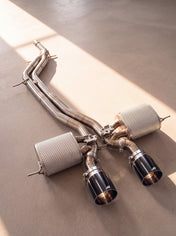
 Porsche Cayenne Coupé Turbo GT 9YB V8 4.0 biturbo Klapeli Egzoz Sistemi (2022+)Başlangıç fiyatı 3 960 € · free delivery · 20 working days
View

Your Rog exhaust for the Porsche Cayenne Coupé Turbo GT 9YB V8 biturbo
Configure my exhaustThe short answer.
- For
- Porsche Cayenne Coupé Turbo GT, type 9YB, one Rog product page
- Engine
- 4.0-litre twin-turbo V8, 640 hp, 850 Nm
- Exhaust
- Valved cat-back, from the downpipe to the outlets
- Control
- Valves fitted, remote with two buttons
- Material
- 304 stainless steel, or brushed, gold or purple titanium
- Downpipe
- 200-cell or 100-cell downpipe, or catalyst-free, as an option
- Tips
- Chrome, gloss black, blued titanium, or no tips
- Lead time and warranty
- 20 working days of manufacturing, free delivery, 3-year warranty
Your vehicle.
All our exhausts for this generation, version by version, are brought together on one page: Porsche Cayenne 9YA / 9YB Valved Exhaust.
The Turbo GT is the version Porsche placed above all the others in the Cayenne range. Coupé body only, reworked V8, power raised by more than eighty horsepower over the Turbo coupé: everything in this car is designed for performance. Yet its exhaust remains that of a large luxury SUV, and it is this tension that the guide explores before turning to the Rog exhaust.
- Model
- Porsche Cayenne Coupé Turbo GT, summit of the Cayenne range
- Body style
- Coupé only, designated 9YB by the Rog product page
- Model years
- Unveiled in 2021; the Rog product page covers 2022 and the following years
- Engine
- 4.0-litre V8 with two turbos, direct injection
- Power and torque
- 640 hp and 850 Nm
- Drivetrain
- All-wheel drive, with a specifically tuned chassis
- Gearbox
- Eight-speed Tiptronic S, torque-converter automatic
- Neighbours
- Cayenne Turbo 9YA, Cayenne GTS 9YA, Cayenne E3 3.0 V6, each with its own guide
The most radical Cayenne
In the history of the Cayenne, few versions have taken the idea of the sporty SUV as far as the Turbo GT. Porsche presented it in 2021 as the flagship of the family, available only as a coupé.
This positioning says a lot about its owners. You buy it as a grand tourer able to carry four people and their luggage, but also as a performance machine that owns its performance. It is typically the kind of vehicle for which a factory sound that is too well-behaved leaves a void: the mechanics say one thing, the exhaust tells another.
9YA or 9YB: how to read the codes
The third-generation Cayenne, sold in SUV and coupé forms, is known by several type codes. For the Turbo GT, our line is designed for the 9YB, which corresponds to the coupé body. The more ordinary 550 hp Cayenne Turbo falls under another guide and another product page, as do the V8 GTS and the V6 model.
This distinction weighs on the choice of exhaust: length, layout and outlets are not identical from one version to another. The VIN, sent with the order, settles it before manufacturing, and the exhaust is made for your exact car, not for another variant of the family.
The 4.0-litre twin-turbo V8
The Turbo GT's engine is a 4.0-litre V8 boosted by two turbochargers, with direct injection. The claimed power reaches 640 hp for 850 Nm. Porsche states that it reworked most of the internals compared with the Turbo coupé's, such as the crankshaft, connecting rods, pistons, valve timing drive and torsional vibration dampers, to withstand this level of power.
The result is a car capable of extraordinary acceleration for a vehicle of more than two tonnes. The 850 Nm of torque gives this thrust a breadth that you feel well before the top of the rev counter.
The exhaust's product page publishes the factory values; it uses no tuned value, because sources diverge on this point. Only the factory figures therefore appear in this guide.
Eight-speed gearbox and all-wheel drive
The Turbo GT uses an eight-speed Tiptronic S gearbox, of torque-converter automatic design, and an all-wheel drive that splits torque between the two axles. The chassis has also received a particular tuning.
For the exhaust, these elements have an indirect consequence. An eight-speed gearbox allows you to cruise at low revs on fast roads, while all-wheel drive weighs on the total mass: the heavier the car, the more the weight saving from titanium counts. The exhaust is made to the VIN, and these characteristics are taken into account.
What Porsche did with the factory exhaust
Porsche states that the Turbo GT receives a lightened exhaust system, whose outlets are central. The manufacturer also specifies that the centre silencer has been removed: the whole weighs about 18 kg less than the Cayenne Turbo's. The car therefore draws part of its sound from this work.
Despite these efforts, the whole remains cautious: at full revs, the timbre is polished, far from what the acceleration leads you to expect.
The V8's voice, and what is taken from it
A twin-turbo V8 has a deep timbre, with that characteristic roll of V-eight engines that rumbles when you lift off. On the factory Turbo GT, this roll is guessed at more than heard.
On our scale of 0 to 10, the standard exhaust sits at around 3. Downshifts have no relief, standing starts do not announce themselves, and the thrust under load is accompanied mainly by turbo whoosh. The car impresses far more by its figures than by its timbre.
What the Rog exhaust changes
With the valves open, the Rog exhaust lets you perceive the eight cylinders under load: a start that announces itself, accelerations where the grain of the V8 can be read, more present downshifts. The Rog cat-back alone sits at 7 on the scale, and the optional downpipe raises that figure.
With the valves closed, the Cayenne becomes a grand-luxury coupé SUV again: silent, calm at a steady speed, ready for everyday journeys. It is this dual use that makes a valved exhaust worthwhile on a car with such a gap between its two faces.
The valves: fitted by Rog, operated remotely
The valves are fitted on the exhaust and obey a two-button remote, connected to a small control unit housed in the boot. Open, they stay open, whatever the drive mode chosen on the car; closed, they stay closed. The volume is therefore decided on demand, independently of the Cayenne's settings.
Rog makes the exhaust to the VIN. Your garage fits it without welding or cutting, with clamps and gaskets.
304 stainless steel or titanium, and the tips
304 stainless steel offers a full, round timbre, resists the salt of winter roads and remains the most common choice. Titanium takes off about 40% of the weight for the same design, which counts on a car of this mass, and gives a clearer, more metallic note in the revs. It is ordered brushed, gold or purple.
Four tip finishes are offered by the product page: chrome, gloss black, blued titanium, or no tips. This choice changes the coupé's rear look, not its sound. Gloss black matches a dark body, chrome a light colour, and blued titanium carries on the look of a titanium exhaust.
The downpipe, as an option
The product page optionally offers the catalytic downpipe, placed at the turbo outlet. It comes in three levels: the 200-cell keeps the emissions control; the 100-cell is subject to the inspector's verdict, which varies with the car and the country; the catalyst-free version gives the freest sound. The "No downpipe" option keeps the standard downpipe.
Alone, without a map, the downpipe changes only the sound and the weight. With a remap carried out by a tuner used to recent Porsches, it lets the V8 breathe more freely. The cat-back, for its part, requires no adjustment of the control unit.
Configure your exhaust.
How the exhaust is put together
On the Turbo GT, the Rog exhaust starts after the downpipe, follows the coupé's underbody, then reaches the silencers, the valves and the tips. The catalytic downpipe, at the turbo outlet, can be replaced as an option on the product page.
Each choice explained in detail, from sound to material: How to configure your exhaust.
Your exhaust for the Turbo GT
On the product page, you select stainless steel or titanium and its shade, the downpipe (standard, 200-cell, 100-cell or catalyst-free) and the tip finish: chrome, gloss black, blued titanium or no tips. The valves arrive fitted, with their Rog remote.
The price of each configuration is shown on the product page, in your currency.
Your choices carry over to the product page: only the finishes, your VIN and the cart remain.
Three recommended configurations.
-
Everyday Turbo GT
- Stainless steel
- No downpipe
- Gloss black tips
- Rog remote
For a Turbo GT that serves all year round: sturdy stainless steel, standard downpipe, and the V8 that speaks only when you decide.
View this configuration -
Lightened grand touring
- Brushed titanium
- 200-cell downpipe
- Blued titanium tips
- Rog remote
For a coupé for big roads: titanium that lightens this mass, 200-cell that keeps the emissions control, and matching blued tips.
View this configuration -
Track day
- Purple titanium
- Decat downpipe
- Chrome tips
- Rog remote
For a Turbo GT driven on the track: catalyst-free downpipe, purple titanium and chrome tips for the pits.
View this configuration
From order to fitting.
VIN, manufacture, delivery, fitting and warranty, step by step
Questions.
Why does the Turbo GT product page talk about 9YB?
The Turbo GT is only sold as a coupé, and the product page files this body under the code 9YB. The 550 hp Cayenne Turbo has its own exhaust, and the VIN settles it before manufacturing.
Does the factory Turbo GT already have a sports exhaust?
Porsche states a lightened system, without a centre silencer, with central outlets. Even so, the voice remains polished on our scale, at around 3 out of 10. The Rog exhaust aims precisely at this gap.
What is the difference between the Turbo GT and the Cayenne Turbo?
The Turbo GT is exclusively a coupé, ninety horsepower more powerful according to Porsche, with a reworked V8 and a chassis tuned accordingly. Each has its Rog product page, because the layouts are not the same.
Do you need to remap the Turbo GT to benefit from the downpipe?
Yes: it is the map that converts the gained flow into power. The tuning values published for this model diverge, so none is used here. The cat-back alone needs no adjustment.
Does the Turbo GT stay peaceful with the exhaust, valves closed?
Yes. With the valves closed, the gases pass through the silencer and the coupé keeps its grand touring calm. You open at the moment you want with the remote.
Do the tips change the Turbo GT's sound?
No. Chrome, gloss black or blued titanium change only the coupé's rear look. The sound depends on the material, the downpipe and the position of the valves.
Porsche Cayenne Coupé Turbo GT 9YB V8 4.0 biturbo Klapeli Egzoz Sistemi (2022+)
Başlangıç fiyatı 3 960 € · 3-year warranty
Configure my exhaustA question about your Cayenne Turbo GT?
Put it to the Rog Advisor or write to us: we reply in writing, within 24 hours.
Further reading.
Sonraki okumalar
- Porsche Panamera 976 exhaust: which one to choose? The Panamera type 976 opens the third generation of Porsche's grand tourer, and its entry-level version relies on...
- Porsche Panamera Turbo S E-Hybrid 971 exhaust: which one to choose? The Panamera Turbo S E-Hybrid 971 combines a 4.0-litre twin-turbo V8 with an electric motor, for a combined...
- Porsche Panamera 971 4.0 V8 exhaust: which one to choose? The Porsche Panamera / Sport Turismo 971 combines the space of a large saloon with the performance of...