
Porsche 911 Carrera 991 exhaust: which one to choose?
The 911 Carrera of type 991.1 keeps its flat-six in the back, and that is precisely why the slightest change to its exhaust is heard at once. Rog makes for it, to the VIN, a valved cat-back in 304 stainless steel or titanium, with the manifolds as an option. This guide presents the car, its two engine sizes and its body styles, then the exhaust that suits it.
Your valved exhaust for Porsche 911 Carrera 991.1 is configured from your VIN, and the Porsche 911 991 Valved Exhaust page brings together every system we make for this generation.
 Porsche 911 Carrera 991.1 3.4 / 3.8 Klapeli Egzoz Sistemi (2012-2015)Başlangıç fiyatı 2 670 € · free delivery · 20 working days
View

Your Rog exhaust for the Porsche 911 Carrera type 991.1
Configure my exhaustThe short answer.
- For
- Porsche 911 Carrera type 991.1, from 2012 to 2015, one Rog product page
- Engine
- Naturally aspirated flat-six, 3.4 litres or 3.8 litres depending on the version
- Body styles
- Coupé, cabriolet and Targa 4 / 4S
- Exhaust
- Valved cat-back, from the front joint to the tips
- Material
- 304 stainless steel, or brushed, gold or purple titanium
- Manifolds
- 200-cell or 100-cell manifolds, or catalyst-free, as an option
- Tips
- Chrome, gloss black, blued titanium, or no tips
- Lead time and warranty
- 20 working days to make, free delivery, 3-year warranty
Your vehicle.
All our exhausts for this generation, version by version, are brought together on one page: Porsche 911 991 Valved Exhaust.
The 991 is the seventh generation of the 911, presented in Frankfurt in 2011 and sold until 2019. It splits into two quite distinct eras: the 991.1, which our product page covers, stays faithful to the naturally aspirated flat-six, whereas the 991.2 switches to turbocharging. This guide is therefore aimed at owners of a Carrera with a naturally aspirated engine, the one whose timbre makes the reputation of the line.
- Model
- Porsche 911 Carrera, type 991.1, generation presented in 2011
- Model years of the product page
- 2012 to 2015, before the switch to forced induction
- Body styles
- Coupé, cabriolet and Targa 4 / 4S
- Engine
- Horizontally opposed flat-six, naturally aspirated, 3.4 litres or 3.8 litres
- Power and torque
- 350 hp and 390 Nm for the 3.4 litre; 400 hp and 440 Nm for the 3.8 litre
- Gearboxes
- Seven-speed manual, or seven-speed dual-clutch PDK
- Drivetrain
- Rear-wheel drive, or all-wheel drive on the Carrera 4 and 4S
- Neighbours in the range
- Turbo S 991.1 and Carrera 991.2, which each have their own guide
One generation, two eras
When Porsche unveils the 991 in the autumn of 2011, the brand highlights a world first: a seven-speed manual gearbox. The first deliveries take place in 2012, and it is this period, up to 2015, that the code 991.1 designates.
In the autumn of 2015, the Frankfurt show displays the facelifted car, the 991.2. It drops the naturally aspirated flat-sixes of the Carrera in favour of a 3.0-litre engine with two turbochargers. Everything then changes for the ear: the layout of the exhaust, the timbre and the way the engine climbs through the revs. That is why the 991.1 and the 991.2 do not share their Rog exhaust and have two separate guides.
The naturally aspirated flat-six, 3.4 litres and 3.8 litres
The engine of the base Carrera is a 3.4-litre flat-six, for which the manufacturer states 350 hp and 390 Nm. The Carrera S gets a displacement increased to 3.8 litres: 400 hp and 440 Nm. In both cases it is an engine without a turbo, which gets its vigour by climbing towards the red zone rather than by pushing from tickover.
This character explains what you expect from an exhaust on this car. A naturally aspirated engine responds above all to the breathing of its intake and exhaust, and its voice gains intensity with the revs. The figures on the product page, just below, are a reminder that extra power comes through the remap; the cat-back works first and foremost on voice and weight.
Standard 350 hp version
Power
Torque
Factory 400 hp version
Power
Torque
Stage 2: published figures with the manifolds and an ECU remap carried out by a tuner.
Coupé, cabriolet and Targa
The 991.1 family covers several shapes: the coupé, the soft-top cabriolet and, since the Detroit show of 2014, the Targa 4 and 4S with its fixed hoop. There are also Carrera 4 and 4S models with all-wheel drive, which arrived in the autumn of 2012. Under the floor, all these variants come together: the Rog product page treats them in one go.
The GTS, which appeared at the end of 2014, completes the top of the naturally aspirated range with more power than the S. Our product page mentions it among the compatible cars; before any order, the VIN lets us check the precise version and its model year.
Seven-speed manual or PDK
The 991 offers two transmissions. The manual gearbox has seven speeds, a world first when it was presented. The PDK is a dual-clutch gearbox, also with seven speeds.
This choice matters little for the Rog exhaust, which extends the outlet of the manifolds to the tips. It does, however, influence what you perceive on board: a PDK chains its shifts very quickly, which leaves little silence between two rises in revs, whereas with the manual the driver sets these pauses personally.
An engine at the back, a short exhaust
On the 911, the flat-six sits in a rear overhang. The gases therefore have only a short distance to travel to the silencers, and any change to the exhaust is heard straight away, without the filtering effect a long central tunnel would bring. This is one of the reasons the 911 is the sports car that reacts most frankly to an exhaust.
This position also has a consequence for mass. Every kilogram removed at the rear is felt on a car whose engine overhangs the axle, and the product page states that the original exhaust weighs 28.6 kg. Lightening this assembly, which titanium makes possible, is therefore no detail.
The Carrera's voice as Porsche delivers it
A flat-six has an immediately recognisable signature: a metallic, slightly gravelly timbre that brightens as the engine climbs. On the standard Carrera, this character is certainly there, but it arrives filtered. The large-volume silencers, calibrated for noise limits, round everything off and bring the engine back to a rather well-behaved presence.
At low revs, you mostly hear a rush of air and the mechanics; the car's true voice appears only at the top of the rev counter. It is this restraint that owners seek to lift, without sacrificing the comfort of ordinary days.
What the Rog exhaust changes
With the valves open, the flat-six recovers its gravelly timbre from tickover, a more linear climb through the revs and, on lifting off, crisp crackles. The exhaust keeps the typical colour of flat engines, which no other layout reproduces.
With the valves closed, the Carrera becomes an easygoing sports car again, calm in town as on the motorway. On our scale of 0 to 10, the standard exhaust sits around 3 and the Rog cat-back alone reaches 7 with the valves open. The rest of the scale depends on the manifolds chosen.
Valves fitted by Rog, operated remotely
The exhaust is delivered with its valves already fitted, along with a remote whose small control unit sits in the boot. Open, they stay open, whatever the drive mode; closed, they stay closed. The driver thus decides the volume at every moment, without depending on a setting of the car.
Rog makes the exhaust to the VIN, and your garage fits it without welding or cutting, with clamps and gaskets.
Stainless steel or titanium
304 stainless steel gives a full, round sound, ages without trouble and withstands winter salt; it is the choice of 911s driven all year round. Titanium lightens the exhaust by about 40% for the same design, which matters here, and takes on a brighter, more metallic note at high revs.
Titanium is chosen in three shades: brushed, gold or purple. Brushed suits the sobriety of a white or grey Carrera, gold warms up a dark body and purple gives a more assertive accent.
The manifolds, as an option
Under the name "Manifold", the product page offers the manifolds of the 911, in which the catalytic converter sits. On a naturally aspirated engine, their design governs cylinder filling at high revs. The gain stays modest, between 3 and 8% or so, and exists only with a remap; poorly designed, such a part would even lose torque at low revs.
The 200-cell version keeps emissions control. The 100-cell depends on the vehicle and the rules of your country; the catalyst-free version gives the freest sound. Choosing "No manifold" leaves the standard manifolds in place.
The tips
Three finishes are offered, chrome, gloss black and blued titanium, or no tips if you keep your own. This choice changes the 911's tail, not its timbre. Gloss black suits light shades, blued titanium naturally continues a titanium exhaust.
Model years and versions to check
The product page covers 2012 to 2015, the whole 991.1. If your car dates from 2016 or later, it carries the turbo engine of the 991.2 and belongs to another guide. For a transitional Carrera, or a GTS, simply send the VIN: we confirm compatibility before starting manufacturing.
Configure your exhaust.
How the exhaust is put together
On the 911 991.1, the Rog exhaust starts at the joint behind the manifolds, runs along the underside of the body, then reaches the silencers, the valves and the outlets at the rear. The manifolds and their catalytic converter, in contact with the flat-six, are offered as an option on the product page, under the name "Manifold".
Each choice explained in detail, from sound to material: How to configure your exhaust.
Your exhaust for the 911 Carrera 991.1
On the product page, you choose stainless steel or titanium, the titanium shade, the tips and, if you wish, the manifolds in 200-cell, 100-cell or catalyst-free form. The valves arrive fitted, with their Rog remote.
The price of each configuration is shown on the product page, in your currency.
Your choices carry over to the product page: only the finishes, your VIN and the cart remain.
Three recommended configurations.
-
Carrera for every day
- Stainless steel
- No manifold
- Rog remote
For a 911 used all year: standard manifolds, the round timbre of stainless steel and valves that you close again on the motorway.
View this configuration -
Cabriolet for fine roads
- Brushed titanium
- 200-cell sport manifold
- Rog remote
For a cabriolet or a Targa with the roof open: lightened titanium, 200-cell manifolds that keep emissions control and a flat-six clearly audible through the revs.
View this configuration -
Carrera for the track
- Purple titanium
- Catalyst-free manifold
- Rog remote
For a 911 that runs on the circuit: catalyst-free manifolds, a titanium exhaust and outlets that get noticed on the grid.
View this configuration
From order to fitting.
VIN, manufacture, delivery, fitting and warranty, step by step
Questions.
Does my 3.8-litre Carrera S receive the same exhaust as the 3.4 litre?
Yes. Both engine sizes of the 991.1 are covered, from 2012 to 2015. Only the VIN, checked before manufacturing, flags a particularity specific to your car.
My 911 is a 2016 991.2: does this product page suit it?
No. From 2016, the Carrera switches to the 3.0-litre turbo engine, with a different layout under the body. It has its own guide, listed at the bottom of the page.
Do coupé, cabriolet and Targa share the same exhaust?
Yes. The flat-six and the layout under the floor are common to these body styles, including the Carrera 4 models and the Targa 4 / 4S, hence a single product page.
Do my PDK or my manual gearbox change anything?
No. The Rog exhaust starts behind the manifolds and does not depend on the gearbox. The VIN nonetheless confirms the version before manufacturing starts.
How much weight does the standard exhaust put on the rear of a 991.1?
28.6 kg according to our product page. In titanium, the Rog exhaust gains about 40% in lightness over stainless steel for the same design, a real gain on an engine placed in a rear overhang.
What is the point of manifolds on a naturally aspirated flat-six?
They improve filling at high revs, but only with a suitable remap. Without a remap, the cat-back alone is enough for the voice, and the 991.1 keeps its original map.
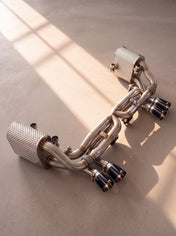
Porsche 911 Carrera 991.1 3.4 / 3.8 Klapeli Egzoz Sistemi (2012-2015)
Başlangıç fiyatı 2 670 € · 3-year warranty
Configure my exhaustA question about your 911 Carrera 991.1?
Put it to the Rog Advisor or write to us: we reply in writing, within 24 hours.
Further reading.
Sonraki okumalar
- Porsche Panamera 976 exhaust: which one to choose? The Panamera type 976 opens the third generation of Porsche's grand tourer, and its entry-level version relies on...
- Porsche Panamera Turbo S E-Hybrid 971 exhaust: which one to choose? The Panamera Turbo S E-Hybrid 971 combines a 4.0-litre twin-turbo V8 with an electric motor, for a combined...
- Porsche Panamera 971 4.0 V8 exhaust: which one to choose? The Porsche Panamera / Sport Turismo 971 combines the space of a large saloon with the performance of...