
Best valved exhaust for Alfa Romeo Giulia 2.0 Turbo (952)
For an Alfa Romeo Giulia 2.0 Turbo, the best valved exhaust is the one made to your VIN, with a sound you choose, so that the saloon finally has a voice to match its character. That is what the Rog exhaust offers: a cat-back in 304 stainless steel or titanium, with the price shown on the product page, in your currency. This guide brings together what you need to know about your car, then helps you choose your exhaust in five decisions.
Your valved exhaust for Alfa Romeo Giulia 952 is configured from your VIN, and the Alfa Romeo Giulia 952 Valved Exhaust page brings together every system we make for this generation.
 Valved Exhaust System for Alfa Romeo Giulia 952 2.0 Turbo (2017-2019)From $3,798 · free delivery · 20 working days
View

Your Rog exhaust: Alfa Romeo Giulia 2.0 Turbo
Configure my exhaustThe short answer.
- Vehicle
- Alfa Romeo Giulia 952 2.0 Turbo, 200 or 280 hp, from 2017 to 2019
- Exhaust
- Valved cat-back, made to your VIN
- Sound
- A single character, designed for this engine
- Material
- 304 stainless steel or titanium (brushed, gold or purple)
- Front section
- Optional sports catalytic converter or decat
- Valves
- Rog remote or factory valves
- Lead time
- 20 working days, free delivery
- Warranty
- 3 years, parts and workmanship
Your vehicle.
All our exhausts for this generation, version by version, are brought together on one page: Alfa Romeo Giulia 952 Valved Exhaust.
The Giulia 952 brought the large sports saloon back to Alfa Romeo. The Rog exhaust covers its 2.0 Turbo versions built from 2017 to 2019, in both power outputs, 200 and 280 hp.
- Body style
- 952 saloon
- Years covered
- 2017 to 2019
- Engine
- 2.0-litre turbo petrol four-cylinder
- Factory output
- 200 hp and 330 Nm, or 280 hp and 400 Nm depending on the version
- Emissions control
- Catalytic converter in the downpipe
- Factory valves
- Controlled by the drive modes on cars fitted with them
What holds back the factory sound
The Giulia has everything a keen driver could want, except the voice: its factory exhaust filters the four-cylinder so heavily that you can barely hear it, even when you push it.
What the Rog exhaust changes
With the Rog exhaust and the valves open, the saloon takes on a full, almost Latin tone, real presence under acceleration and crisp crackles on the overrun; with the valves closed, it becomes discreet again. Power only changes with the downpipe and a remap: here are the published figures.
Power
Torque
Factory figures by version; Stage 2 published for the 280 hp version, with a remap.
Is your Giulia from 2016 or 2020? Send us your VIN before ordering: we will check the exhaust.
Closely related versions have their own guide: Alfa Romeo Giulia Quadrifoglio 2.9 V6, Alfa Romeo 4C 960, Alfa Romeo Giulietta 940.
Choosing your exhaust.
Five decisions, in this order: each one builds on the one before, and the last no longer affects the sound. Before you start, here is what you are buying.
Your exhaust, in two parts
The cat-back is the complete exhaust system
Everything you see under the car, from the end of the front section to the tips: pipes, silencers, valves. It is what creates the sound, and it is what you configure first.
The front section, where the catalytic converter sits
On this turbo engine, it is the downpipe, at the turbo outlet, with the factory catalytic converter: the second restriction in the exhaust after the silencer. Replacing it is an option (step 3).
-
Step 1 of 5: Sound: the voice of your car
An exhaust's sound is shaped in three places: its character, which you choose here; its intensity, which depends on the front section (step 3); and the volume of the moment, which you set with the valves (step 4).
The character
On this exhaust, the character is not an option you choose: it has a single voice, designed for this engine. You can go straight to the material.
Our advice. Here, the character is that of the exhaust itself: you choose your sound at step 3, with the front section, and day to day with the valves. Valved exhaust: how it works, price and vehicle inspection.
-
Step 2 of 5: Material: stainless steel or titanium
The material changes three things: weight, sound and durability. It is a genuine technical choice, not just a matter of looks.
304 stainless steel
Base price
- Weight
- Baseline
- Sound
- Full and rounded
- Durability
- Withstands salt and winter
Tough, corrosion-proof, with a full, rounded sound. The choice of most of our customers.
Titanium
Optional
- Weight
- Around 40% lighter
- Sound
- Metallic, crystal-clear
- Durability
- Does not rust
Around 40% lighter than stainless steel for the same design, with a more metallic sound that turns crystal-clear at high revs. You then choose it in one of three colours, at the same price (step 5).
Our advice. Stainless steel for a first purchase and everyday use; titanium if you are chasing every kilo and want a higher-pitched note at high revs. Over time, both last. Stainless steel or titanium: what really changes.
-
Step 3 of 5: Front section: sports catalytic converter or decat
On your car, the front section is the downpipe, at the turbo outlet: that is where the catalytic converter sits. After the exhaust itself, it is the part that matters most, for sound as well as for breathing. It is optional; on the product page, this option is called “Manifold”: it is the same part, catalytic converter included.
Cat-back only
Included
7/10Factory catalytic converter retained
You keep the factory front section. It already makes it a different car: most of our customers start here.
200-cell sports catalytic converter
Optional
8/10Road use and inspection
Emissions control stays in place, flow improves markedly and the sound gains presence. Our choice for the road.
100-cell sports catalytic converter
Optional
9/10Inspection: depends on the vehicle
Half as many cells: more breathing and more aggression at high revs.
Decat
Optional
10/10Track use
No emissions control: maximum flow and raw sound, for the track.
Sound intensity, on a scale of 0 to 10
- 10/10Decat downpipe + Rog cat-back
- 9/10100-cell sports catalytic converter + Rog cat-back
- 8/10200-cell sports catalytic converter + Rog cat-back
- 7/10Rog cat-back only, factory catalytic converter retained
- 3/10Factory exhaust, for comparison
Valves open. With the valves closed, every configuration becomes discreet again.
Our advice. Your reference point is a score out of 10: 7 with the exhaust alone, 8 to 9 with the 200-cell sports catalytic converter, 10 with the decat version, for the track. With a remap by a tuner, it is also the front section that unlocks the power (see “Your vehicle”).

The downpipe with sports catalytic converter, as shown on the product page. What about the engine warning light? With a sports catalytic converter, it can come on with some engines: the sensor placed after the catalytic converter measures a different level of emissions control from the original. It is not a mechanical fault, and a remap by a tuner sorts it out. The decat version almost always triggers it. Passing inspection with a sports exhaust.
-
Step 4 of 5: Valves: our remote or your factory valves
The valves set the volume at every moment: closed, the gases pass through the silencer and the car keeps a sound close to the factory one; open, they take the shortest route. All that remains is to choose who controls them.
Rog system and remote
Included

The exhaust comes with our valves fitted and a two-button remote, open and closed; a small control unit fits in the boot. The valves stay in the position you choose, whatever the drive mode: open, they stay open; closed, they stay closed.
Your factory valves
Included
- If your car has factory valves
- Controlled by the drive modes
If your car has factory valves, we deliver the exhaust with mounting points for them: your garage refits your valves there, and everything works as before, through the drive modes.

Valves open, valves closed: the path the gases take through the silencer. Our advice. The remote if you want to decide for yourself, at any time; your factory valves if you value the standard drive modes. For inspection, present the car with the valves closed. On track, open them: that is where they come into their own.
On the motorway, with the valves closed, the gases pass through the silencer, designed for cruising: no drone at a steady speed. You open up when you feel like it, not when the motorway decides for you. Why our exhausts stay calm on the motorway.
-
Step 5 of 5: Looks: the titanium colour
The last step, and the freest. The titanium colour is a purely aesthetic choice: it changes nothing about the sound or the performance of the exhaust. Choose it with your eyes.
The titanium colour
Three colours, at the same price: brushed, gold or purple. They only apply to titanium; in stainless steel, the exhaust keeps the colour of the steel.

Brushed 
Gold 
Purple
Your choices carry over to the product page: only the finishes, your VIN and the cart remain.
Three set-ups, three uses.
If you are still unsure, start from how you use the car: here are the three set-ups we recommend most often for your car.
-
Everyday
- Stainless steel
- Cat-back only
- Rog remote
Your car finds its voice, the factory emissions control stays in place, and you open the valves when you decide.
View this configuration -
Fast road
- Titanium
- 200-cell sports catalytic converter
More sound and more breathing, with emissions control retained. With a remap, it is the basis of a Stage 2.
View this configuration -
Track
- Titanium
- Decat
For the track: maximum flow and raw sound. And on track, the valves stay open.
View this configuration
From order to installation.
-
Configuration
You choose your exhaust and enter your VIN, found in box E of your registration document.
-
Check
We check compatibility with your VIN before manufacturing begins.
-
Manufacturing
Your exhaust is made to order, for your car.
-
Delivery
Free, insured to your door, tracked from dispatch.
-
Installation
At your garage, with no welding or cutting: clamps, new gaskets and roughly two hours on a lift.
20 working days from order confirmation to delivery
- Warranty
- 3 years, parts and workmanship, from the date of purchase
- Payment
- Card, PayPal or bank transfer
- Installation
- By the garage of your choice
Every exhaust is made to your VIN and checked before production: it fits your car perfectly.
Questions.
What does an Alfa Romeo Giulia 2.0 Turbo sound like with a Rog exhaust?
With the valves closed, the car stays close to its factory sound. With the valves open, the engine takes on a full, sporty voice: 7 out of 10 on our scale with the exhaust alone, 8 to 9 with a sports catalytic converter, 10 with the decat, compared with 3 for the factory exhaust.
Which Giulia 952 cars are covered?
All 2.0 Turbo saloons built from 2017 to 2019, whether they have 200 or 280 hp. A Giulia from 2016 or 2020? Send us your VIN: we check before manufacturing.
Does the car need a remap, and what is the gain?
Not with the exhaust alone, which leaves the ECU as it is. At Stage 2, with the downpipe and a remap by a tuner, the published figures for the 280 hp version are 326 hp and 483 Nm.
Can you pass vehicle inspection with a Rog exhaust on an Alfa Romeo Giulia 2.0 Turbo?
Present the car with the valves closed: it returns to a sound level close to factory. With the exhaust alone or the 200-cell sports catalytic converter, emissions control stays in place; a 100-cell depends on the vehicle and the rules in your country, and the decat version is intended for the track.
Factory valves or Rog remote?
With your factory valves, it is the car, through its drive modes, that decides. With the Rog system, a two-button remote opens or closes them at any time, and they stay in the position you choose.
Does the exhaust drone on the motorway?
No. With the valves closed, the gases pass through the whole silencer, and at a steady speed the cabin stays calm: our exhausts are designed to avoid that drone. You open up when you decide.
How is the Rog exhaust fitted on an Alfa Romeo Giulia 2.0 Turbo?
By your garage, with no welding or cutting: clamps, gaskets and around two hours on a lift are all it takes. The parts arrive ready to fit, with their fixings.
How long does it take to receive a Rog exhaust for an Alfa Romeo Giulia 2.0 Turbo?
Allow 20 working days from order confirmation to delivery, the time it takes to make your exhaust. Delivery is free and tracked from dispatch.
What warranty comes with a Rog exhaust for an Alfa Romeo Giulia 2.0 Turbo?
3 years, parts and workmanship, from the date of purchase. As for Alfa Romeo's warranty: in Europe, a manufacturer cannot refuse it simply because a part from another brand has been fitted; it has to prove that the fault comes from that part.
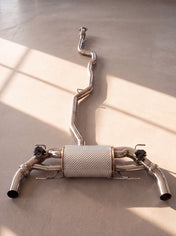
Valved Exhaust System for Alfa Romeo Giulia 952 2.0 Turbo (2017-2019)
From $3,798 · 3-year warranty
Configure my exhaustA question before you order? Write to us.
The right choice depends on how you use your car and on the car itself. Ask the Rog Advisor or write to us: we reply in writing, within 24 hours, and we help you choose, including a cheaper option if that is what suits the way you drive.
Your VIN, in box E of your registration document, is all we need to check compatibility before manufacturing.
Further reading.
- All Alfa Romeo exhaust systems
- Alfa Romeo Giulia Quadrifoglio 2.9 V6
- Downpipe: what is it and what does it do?
- Stage 2: the role of the downpipe
- How to pass vehicle inspection with a modified exhaust
- Pop & Bang: how it works, and is it risky?
- Exhaust and manufacturer's warranty: what you need to know
- All the brands we cover
Read next
- Mercedes-AMG E55 W211 / S211 V8 Kompressor: the wolf in a business suit, the exhaust guide With the E55 W211, AMG slipped a 476 hp, 700 Nm supercharged V8 into an E-Class that looks...
- Mercedes-AMG CLS53 C257: the return of the straight-six, the exhaust system guide A four-door coupé with flowing lines, the CLS53 C257 benefits from Mercedes' return to a layout the brand...
- Toyota GR Supra A90 L6: the B58 takes centre stage, the exhaust system guide The GR Supra A90 revived a legendary line by pairing a short rear-wheel-drive chassis with the B58 3.0-litre...