
Best valved exhaust for BMW M2 F87 (N55)
The first BMW M2 F87, the single-turbo N55 one, deserves a valved exhaust that makes the bass of its six-cylinder audible, while leaving it a life as an everyday coupé. Rog makes it to the VIN of each M2: a cat-back cut from 304 stainless steel or titanium, whose valves either stay under the control of the BMW modes or pass under that of a remote. First the 2016 coupé and its engine, then three configurations that we recommend for it.
Your valved exhaust for BMW M2 N55 F87 is configured from your VIN, and the BMW M2 F87 Valved Exhaust page brings together every system we make for this generation.
 Valved Exhaust System for BMW M2 N55 F87 3.0T (2016-2018)From $4,145 · free delivery · 20 working days
View

Your Rog exhaust: BMW M2 F87 N55
Configure my exhaustThe short answer.
- Vehicle
- BMW M2 coupé F87 with N55 engine, 2016 to 2018 model years, before the arrival of the Competition
- Engine
- N55B30T0, three litres, straight-six, one turbo
- Exhaust
- Valved cat-back, downpipe excluded, all the way to the four tips
- Sound
- Raw grain with a straight pipe, or resonator at no extra cost
- Material
- 304 stainless steel; or brushed, gold or purple titanium
- Front section
- N55 downpipe offered separately
- Valves
- BMW electric valve transferred, or Rog remote
- Lead time and warranty
- 20 working day lead time, free delivery, three-year warranty
Your vehicle.
All our exhausts for this generation, version by version, are brought together on one page: BMW M2 / M2 Competition F87 exhaust system.
In 2016, BMW M brought together in the M2 a compact format, rear-wheel drive, a straight-six and a manual transmission as standard. What sets it apart from the M2s that came afterwards is its engine; so that is where the choice of an exhaust begins.
- Body style
- F87 coupé, two doors, rear-wheel drive
- Arrival in showrooms
- April 2016; succeeded in 2018 by the M2 Competition and its S55
- Engine
- N55B30T0: three-litre inline six-cylinder, a single turbo
- Factory output
- 272 kW, or 370 hp, reached at 6,500 rpm
- Factory torque
- 465 Nm, and up to 500 Nm for the length of an overboost
- Transmissions
- Six-speed manual as standard, seven-speed M DCT with Drivelogic in the options catalogue
- Tailpipes
- Four, grouped in pairs
- Factory valve
- Electrically operated, controlled by Comfort, Sport and Sport Plus
The first chapter of the M2
BMW M unveiled the M2 Coupé in October 2015, and the first cars reached showrooms in April 2016. It starts from the 2 Series coupé, and BMW M gave it a low, wide tail, housing four exhaust tips.
Two years later, the M2 Competition replaced it, with the twin-turbo S55 borrowed from the M3 and M4 of the day. The result: the M2 this guide is about is the only one in the family to run on the N55, a singularity that its owners proudly claim. The Competition and the M2 G87 have separate product pages and guides.
370 hp, and a helping hand from overboost
The M2's N55 reaches 370 hp, or 272 kW, at 6,500 rpm. Its torque peaks at 465 Nm, and overboost takes it for a few moments to 500 Nm by adding 0.1 bar to the usual turbo pressure. BMW M had already used this method on the 1 M Coupé.
Fitted with the M DCT and Launch Control, the M2 reaches 100 km/h from a standstill in 4.3 seconds according to BMW; with the manual transmission, allow two tenths more. Our product page is aimed at M2s produced from 2016 to 2018. Between an M2 and an M2 Competition, any doubt is cleared up by the VIN, which we examine and comment on in writing before you place an order.
Power
Torque
Stage 2: published figures with the front section and an ECU remap carried out by a tuner.
Manual transmission, M DCT and active M differential
Delivered as standard with a lever and three pedals, the M2 F87 could be ordered with the M DCT as an option, a seven-speed dual-clutch transmission that chains the gears together without breaking the thrust and offers several Drivelogic programs. Whichever transmission it has, only the rear wheels pull the car.
Between these wheels, the active M differential electronically adjusts its locking to keep traction and line. The front and rear axles, in aluminum, are taken from the M3 and M4 of the time, and the stability control has an M Dynamic Mode that allows fine slides on the track.
For our cat-back, this question of transmission does not arise: lever or paddles, an N55 M2 receives the same exhaust, validated on VIN before manufacture.
An N55 reworked by BMW M
The N55 powers many BMWs of this era, from the M135i to the 535i, but the M2's version carries the code N55B30T0 and parts from the S55 of the M3 and M4: the crankshaft bearings and the aluminum oil sump. An additional suction pump returns oil to the rear of the sump when acceleration pushes it away, and an oil cooler added at the front right helps the engine cope with track sessions.
A single twin-scroll turbo collects the gases of the six cylinders. The downpipe, with its catalytic converter, connects at its outlet: on the M2, it is what we call the front section. The cat-back takes over and runs to the four tips; this is where the coupé's sound personality is decided.
The voice of a single-turbo six-cylinder
The straight-six has that natural balance that makes its sound continuous: dull at idle, more metallic with every thousand revs gained. As its six cylinders blow into a single turbo, the N55 keeps a lower, gruffer register than the twin-turbo engines of BMW M.
In a coupé as compact as the M2, this voice comes through the steering wheel and the seat. With the exhaust freed, every rise in revs is accompanied by a rasping grain, and lifting off triggers dry crackles, very clear on the M DCT's downshifts.
The product page offers two characters at the same price: the straight pipe, to keep that grain as it is, or the resonator, which gives the N55 a rounder and slightly softer voice, ideal if your M2 also swallows long stages.
A heavy, well-behaved factory exhaust
According to our product page, the standard exhaust of the N55 M2 weighs 21.7 kg. This weight comes from mufflers sized to pass under the noise limits, which dissipate a large part of the N55's sound energy before the outlets.
BMW adds Active Sound Design: inside the cabin, the speakers play a synthetic engine sound. At the wheel, the M2 therefore seems more expressive than it is from the pavement, or for yourself with the windows down.
Our exhaust rebalances things. With the valves shut, the flow winds through every chamber and the M2 hardly raises its voice, which remains welcome when leaving an underground car park early in the morning. With the valves wide open, the flow runs straight through and the N55 can be heard well beyond the cabin.
The electric valve and the drive modes
On the N55 M2, BMW M replaced the vacuum valve of the other 2 Series with an electrically operated valve. In Comfort mode, it stays closed at idle, at low revs and almost all the time, except under heavy load. In Sport and Sport Plus, it opens fully at idle, when stationary and in the first gears, then closes again in certain ranges in the higher gears.
Two possibilities appear on the product page. Factory option: a housing is provided on our exhaust for the BMW valve, which your garage transfers there; Comfort, Sport and Sport Plus carry on operating it in their own way. Rog option: the exhaust reaches you fitted with our valves and a small two-button remote, whose command takes precedence over the selected mode, so that the M2 can stay open in Comfort or closed in Sport Plus.
Four outlets, tips and material
Our exhaust keeps the four outlets of the M2, two at each corner of the bumper. As for trim, three Rog finishes are included, chrome, gloss black and blued titanium, while carbon tips with the M logo, in forged, black or titanium-blended versions, are added as an option. An order with no tips remains possible.
304 stainless steel extends the N55's bass and gets through salty winters without any trouble. Titanium takes around 40% of the mass off the exhaust for the same design, a gain placed at the extreme rear of a short rear-wheel-drive car; its three shades, brushed, gold, purple, change nothing in the price.
What the N55 M2 product page covers
Our cat-back starts where the downpipe ends. The product page offers this downpipe too, under the heading "Manifold", in three versions: sport catalytic converter with 200 cells, with 100 cells, or no catalytic converter, the latter intended for the track.
On its own, the cat-back does not modify the N55's software: the M2 keeps its 370 hp and only changes its voice. To gain power, the downpipe must be accompanied by a remap entrusted to a tuner. Made from your VIN, the exhaust is then fitted at your garage with clamps and gaskets, without any welding.
Configure your exhaust.
How the exhaust is put together
On the N55 M2, Rog supplies the whole exhaust located after the single downpipe: pipework, mufflers, valves and four outlets. This catalyzed downpipe, connected directly to the turbo, can be added to the order under the "Manifold" heading.
Each choice explained in detail, from sound to material: How to configure your exhaust.
Your exhaust for the M2 F87 N55
Configuring the M2 begins with a choice between 304 stainless steel and titanium, offered brushed, gold or purple, before deciding between straight pipe and resonator, priced the same. Next come the optional downpipe, the valve control, via the BMW valve thanks to the Factory option or via our remote, then the trim, Rog tips or carbon tips with the M logo.
The price of each configuration is shown on the product page, in your currency.
Your choices carry over to the product page: only the finishes, your VIN and the cart remain.
Three recommended configurations.
-
The weekday M2
- Stainless steel
- No manifold
- Resonator
- Factory valve
For an M2 that does the commute: a more present but rounded N55, the factory front section kept in place, and the Comfort and Sport modes still controlling the exhaust.
View this configuration -
B-roads
- Titanium
- 200-cell sports catalytic converter
- Straight pipe
- Rog remote
For the manual M2 on weekend back roads: an unfiltered rasping grain, emissions control kept by the 200-cell downpipe, and valves opened or closed at the press of a thumb.
View this configuration -
Track and M Dynamic Mode
- Titanium
- Decat
- Straight pipe
- Carbon tips with the M logo
For an M2 reserved for track days: maximum flow behind the turbo, a rear lightened by titanium, and carbon tips matched to the coupé's character.
View this configuration
From order to fitting.
VIN, manufacture, delivery, fitting and warranty, step by step
Questions.
How do I know whether my M2 is an N55 or a Competition?
The N55 M2 was sold from 2016 to 2018 with 370 hp; the Competition, which arrived in 2018, has the twin-turbo S55 and 410 hp. Each has its own product page. At the slightest doubt, your VIN tells us which one is yours before manufacture.
Will Sport Plus mode still control the exhaust of my M2?
Yes, with the Factory option: your standard electric valve is refitted on the Rog exhaust, and Comfort, Sport or Sport Plus carry on opening and closing it. With the Rog option, the remote takes over, whatever the mode.
How much louder does the N55 M2 get?
We place its standard exhaust at 3 on our scale of 10. With the Rog cat-back alone, valves open, it climbs to 7; add the downpipe and it goes beyond. Once the valves are closed again, the coupé returns roughly to the volume it had on delivery.
My M2 has the M DCT transmission: do I need a particular exhaust?
No. With three pedals or with the M DCT, the N55 M2 receives exactly the same cat-back, checked on VIN before manufacture.
Should I prefer the straight pipe or the resonator for this N55?
Take the straight pipe if you like the gravelly grain of the single turbo and its crackles. The resonator gives it a rounder and slightly softer voice, welcome on long stages. The price is the same.
What does the M2 gain from switching to titanium?
Around 40% less weight on the exhaust, for the same design, and a clearer note at high revs. On a short coupé, this gain sits right at the back, behind the axle.
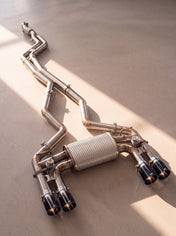
Valved Exhaust System for BMW M2 N55 F87 3.0T (2016-2018)
From $4,145 · 3-year warranty
Configure my exhaustA question about your N55 M2?
Put it to the Rog Advisor or write to us: we reply in writing, within 24 hours.
Further reading.
Read next
- Mercedes-AMG E55 W211 / S211 V8 Kompressor: the wolf in a business suit, the exhaust guide With the E55 W211, AMG slipped a 476 hp, 700 Nm supercharged V8 into an E-Class that looks...
- Mercedes-AMG CLS53 C257: the return of the straight-six, the exhaust system guide A four-door coupé with flowing lines, the CLS53 C257 benefits from Mercedes' return to a layout the brand...
- Toyota GR Supra A90 L6: the B58 takes centre stage, the exhaust system guide The GR Supra A90 revived a legendary line by pairing a short rear-wheel-drive chassis with the B58 3.0-litre...