
Guides Volkswagen Golf 8 GTI / R
Best valved exhaust for Volkswagen Golf 8 GTI
On a Golf 8 GTI, the exhaust that suits it best is a valved system able to make the 2.0 TSI sing at the weekend and forget it again on Monday morning. That is the job of the Rog exhaust, made from the VIN of your GTI in 304 stainless steel or titanium, whether it dates from the early Golf 8 or from the facelifted Golf 8.5. We first describe the car and what smothers its voice, then three configurations chosen for it.
Your valved exhaust for Volkswagen Golf 8 GTI is configured from your VIN, and the Volkswagen Golf 8 GTI / R Valved Exhaust page brings together every system we make for this generation.
 Valved Exhaust System for Volkswagen Golf 8 GTI Mk8 2.0 TSI (2021+)From £2,170 · free delivery · 20 working days
View

Your Rog exhaust for the Volkswagen Golf 8 GTI
Configure my exhaustThe short answer.
- Vehicle
- Golf 8 GTI 2.0 TSI from 2021, Golf 8.5 GTI with 265 hp included
- Engine
- EA888 evo4, 1,984 cc turbo four-cylinder
- Exhaust
- Valved cat-back to both tips
- Sound
- Straight pipe with a raw edge, or resonator with a rounder voice
- Material
- 304 stainless steel or titanium, three shades at the same price
- Front section
- The downpipe, with or without catalytic converter, as an option
- Valves
- Rog system, two-button remote
- Lead time and warranty
- Made in 20 working days, delivered free of charge, 3-year warranty
Your vehicle.
All our exhausts for this generation, version by version, are brought together on one page: VW Golf 8 R / Golf 8 GTI exhaust system.
The GTI is the model that turned the Golf into a sports car, and the eighth generation stays true to the formula: a 2.0 TSI, front-wheel drive, a five-door body. Before choosing an exhaust for yours, here is what sets its versions, its engine and its factory sound apart.
- Generation
- Golf 8 GTI unveiled in 2020; Golf 8.5 GTI facelifted in early 2024
- Product page coverage
- GTIs built from 2021, Golf 8.5 included; a 2020 GTI or a Clubsport is checked against the VIN
- Engine
- EA888 evo4: 1,984 cc four-cylinder with direct injection, one turbo
- Factory output
- 245 hp (180 kW), then 265 hp (195 kW) on the Golf 8.5; 370 Nm in both cases
- Gearbox
- Six-speed manual or seven-speed DSG; DSG only on the Golf 8.5
- Drivetrain
- Front-wheel drive, with a front differential lock as standard
- Tailpipes
- Two round tips, one on each side of the diffuser
The Golf 8, then the Golf 8.5
Volkswagen unveiled the eighth Golf GTI in early 2020, alongside the diesel GTD and the plug-in hybrid GTE, with pre-orders opening the following summer. It keeps the vocabulary of the line, starting with the red stripe across the front, and a five-door silhouette that never shouts about its power.
In early 2024, the Golf 8.5 brought a facelift visible at the front and at the rear, a new central screen and above all a more powerful engine. The Rog product page follows both phases from the 2021 model year: your VIN tells us which GTI it is, and we use it to check compatibility before manufacture begins.
From 245 to 265 hp, and the Clubsport on its own
At launch, the GTI quotes 245 hp, or 180 kW, and 370 Nm. That is the power the previous generation's GTI Performance had, which has become the base figure here. The Golf 8.5 rises to 265 hp, or 195 kW, with torque unchanged at 370 Nm, and Volkswagen then quotes 0 to 100 km/h in 5.9 seconds. In both cases, top speed is electronically limited to 250 km/h.
Above it sits the GTI Clubsport: 300 hp and 400 Nm, with its own tuning and a driving profile dedicated to the Nürburgring. It is not named on the product page. If your GTI is a Clubsport, or was built in 2020, send us its VIN before ordering: we will reply in writing with what suits it.
Power
Torque
Stage 2: published figures with the front section and an ECU remap carried out by a tuner.
Front-wheel drive, front lock and two gearboxes
The GTI remains a front-wheel-drive car, and that is what gives it its character: traction out of corners relies on a front differential lock fitted as standard, completed by the XDS electronic function and coordinated by the Vehicle Dynamics Manager, which also manages the optional DCC adaptive suspension.
Until the facelift, you could choose between a six-speed manual gearbox and the seven-speed dual-clutch DSG. The Golf 8.5 GTI now exists only with the DSG. For the exhaust, this changes nothing: manual or DSG, the same Rog exhaust runs under the body and reaches the two tips.
The EA888 evo4, a single turbo
Under the bonnet works the EA888 in its fourth stage of development, which Volkswagen had until then reserved for the GTI Performance. It is an inline four-cylinder of 1,984 cc, with direct injection, boosted by a single turbo. It shares its family with the Golf 8 R engine, but not its tuning or its front section: the R has its own Rog product page.
The EA888's turbo blows straight into a downpipe, a short pipe fitted with the catalytic converter: this is what we call the front section. Downstream, everything else forms the cat-back: the pipes running along the floor, the rear silencer, the valves and the two tips. This is where most of a GTI's sound is decided, and it is this part that the Rog exhaust replaces first.
What a turbo four-cylinder has to say
In a four-cylinder, one combustion occurs every half turn of the crankshaft: the note is regular, dry, more rhythmic than that of a six-cylinder. On the EA888, the turbo placed just after the manifold absorbs part of these pulsations, and the voice reaches the exhaust already softened. That is why a standard GTI seems so well-behaved, even though its engine is responsive from low revs.
Once the exhaust is opened up, this 2.0 TSI growls at idle, fills with a rasping grain as the turbo builds boost, and crackles when you lift off, all the more with the DSG, which changes gear without a break in drive. The character then depends on a free choice on the product page: a straight pipe that filters nothing of the four-cylinder, or a resonator with which the GTI gains a rounder and slightly softer voice, still decidedly sporty.
Why the standard GTI makes itself heard so little
The factory exhaust of the Golf 8 GTI was designed first for noise regulations and for comfort: its silencers are large, and the gases make a long detour inside them before leaving. The result is measured mostly from outside, where the GTI passes almost unnoticed, even when pushing on.
Inside the cabin, Volkswagen supplements what you hear: a sound generator, which the manufacturer lists in the standard equipment, reinforces the engine sound according to the settings chosen. The effect exists on board, but it changes nothing for passers-by, nor for you with the window down. A valved exhaust acts where the real sound is born: in the pipes and in the silencer.
Valves you decide when to open
For the GTI, the Rog exhaust is delivered with the valves in place, together with a remote: one button opens, the other closes, and the small control unit finds its place in the boot. The driving profile changes nothing: whether you drive in Comfort with the valves open or in Sport with the valves closed, they keep the position you gave them.
Closed, the valves send the gases through the whole silencer: the Golf comes back close to its factory level, useful for the morning start, in a residential street or cruising on the motorway. Open, they offer the gases a shortcut, and the EA888 makes itself heard on a mountain road or a track day.
Two outlets, tips and material
Seen from behind, the GTI is recognised by its two round outlets, placed at the two ends of the diffuser, whereas the R lines up four. For the tips, the product page offers three finishes included, chrome, gloss black or blued titanium; you can also receive the exhaust bare, without tips, to keep the rear understated.
304 stainless steel takes salt and winters in its stride and gives the four-cylinder a full sound. Titanium, about 40% lighter for the same layout, makes the EA888 sound clearer in the revs; its three shades, brushed, gold or purple, are at the same price and dress the rear without changing the sound.
What the product page covers, front section included
A separate option from the cat-back, the front section is called "Manifold" on the product page: it is the GTI's downpipe, offered with a 200-cell catalytic converter, with a 100-cell catalytic converter or without a catalytic converter. For a Golf that goes to work every morning, the 200-cell is the obvious choice, since it keeps emissions control; the version without a catalytic converter is made for the track.
Nothing changes for the engine as long as the GTI's control unit stays untouched: it keeps its 245 or 265 hp, only its voice evolves. To go looking for horsepower, the downpipe has to be combined with a remap, a tuner's job. Your exhaust goes into manufacture once the VIN has been checked, and your garage fits it, with clamps and gaskets, without welding or cutting.
Configure your exhaust.
How the exhaust is put together
On the Golf 8 GTI, the Rog cat-back starts at the end of the downpipe and runs to the two tips on the diffuser, silencer and valves included. Upstream, the front section comes down to this catalytic downpipe, fitted right against the EA888's turbo: the product page sells it separately, under the "Manifold" option.
Each choice explained in detail, from sound to material: How to configure your exhaust.
Your exhaust for Golf 8 and 8.5 GTI
Four questions decide your GTI exhaust: stainless steel or titanium, and in that case which shade among brushed, gold and purple; straight pipe or resonator, at the same price; factory downpipe or replaced one, from the 200-cell to the catalyst-free; and which tips, chrome, gloss black, blued titanium or none. The valves, for their part, obey the Rog remote.
The price of each configuration is shown on the product page, in your currency.
Your choices carry over to the product page: only the finishes, your VIN and the cart remain.
Three recommended configurations.
-
Everyday GTI
- Stainless steel
- No manifold
- Straight pipe
- Rog remote
For the Golf of the daily commute and holiday departures: factory front section kept, and a simple press to free the EA888 on the drive home.
View this configuration -
Mountain roads
- Brushed titanium
- 200-cell sports catalytic converter
- Resonator
A GTI that loves weekend hairpins: more presence on every acceleration, a rounder and slightly softer voice, and emissions control kept.
View this configuration -
Track days
- Titanium
- Catalyst-free manifold
- Straight pipe
For a tuned GTI that strings track sessions together: the freest flow, the raw grain of the four-cylinder and open valves from the first lap to the last.
View this configuration
From order to fitting.
VIN, manufacture, delivery, fitting and warranty, step by step
Questions.
Does my 265 hp Golf 8.5 GTI receive the same exhaust?
Yes. The product page covers the GTI from 2021, before and after the 2024 facelift: the 245 hp version and the 265 hp Golf 8.5 receive the same Rog exhaust. Your VIN is checked before every manufacture.
And for a GTI Clubsport, or a GTI built in 2020?
The 300 hp Clubsport does not appear on the product page, and a 2020 GTI falls outside the period covered. In both cases, send us the VIN before any order; the reply reaches you in writing.
Manual or DSG: is the exhaust different?
No. Both gearboxes of the Golf 8 GTI, the six-speed manual and the seven-speed DSG, receive the same cat-back. The Golf 8.5 GTI exists only with the DSG, and the exhaust stays the same.
The factory GTI already reinforces its sound on board: what does the Rog exhaust change?
The GTI's sound generator acts in the cabin only. The Rog exhaust works on the real sound, in the pipes and the silencer: with the valves open, the EA888 can also be heard from outside; with the valves closed, the Golf comes back close to its factory level.
Straight pipe or resonator on the GTI's 2.0 TSI?
With the straight pipe, the GTI keeps the dry grain of the four-cylinder and its crackles when you lift off. The resonator, at the same price, rounds off the voice: rounder and slightly softer, it suits a GTI that also serves the family.
Can I use the exhaust of a Golf 8 R on my GTI?
No. The R has four tips and a different front section, whereas the GTI has only two: each has its own Rog product page. For the GTI, you must choose the Golf 8 GTI 2.0 TSI product page.
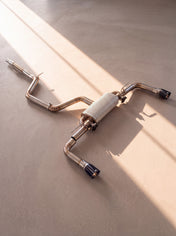
Valved Exhaust System for Volkswagen Golf 8 GTI Mk8 2.0 TSI (2021+)
From £2,170 · 3-year warranty
Configure my exhaustA question about your GTI, Golf 8 or 8.5?
Put it to the Rog Advisor or write to us: we reply in writing, within 24 hours.
Further reading.
Read next
- Mercedes-AMG E55 W211 / S211 V8 Kompressor: the wolf in a business suit, the exhaust guide Mercedes-Benz E 55 AMG W211 or S211 estate: for this E-Class with a supercharged V8, we recommend a...
- Mercedes-AMG CLS53 C257: the return of the straight-six, the exhaust system guide A four-door coupé with flowing lines, the CLS53 C257 benefits from Mercedes' return to a layout the brand...
- Toyota GR Supra A90 L6: the B58 takes centre stage, the exhaust system guide The GR Supra A90 revived a legendary line by pairing a short rear-wheel-drive chassis with the B58 3.0-litre...