
BMW 335i F30 / F31: waking up the N55, the complete exhaust system guide
For a BMW 335i F30 or F31 from 2012 to 2015, the right exhaust is a cat-back with flaps that gives the N55 its raspy voice back without turning the sedan or the Touring into a noisy car day to day. The Rog line is made to your VIN, keeps the factory flap with the Factory option or switches to the remote, and can take a resonator.
Your valved exhaust for BMW 335i F30 / F31 is configured from your VIN, and the BMW 3 Series F30 / F31 Valved Exhaust page brings together every system we make for this generation.
 Valved Exhaust System for BMW 335i F30 / F31 3.0T (2012-2015)From $2,780 · free delivery · 20 working days
View

Your Rog exhaust for the BMW 335i F30 / F31
Configure my exhaustThe short answer.
- For
- BMW 335i sedan F30 and Touring F31, model years 2012 to 2015
- Engine
- N55, 3.0 liters, straight-six with a twin-scroll turbo
- Line type
- Cat-back with flaps, identical for the sedan and the Touring
- Materials
- 304 stainless steel, or brushed, gold or purple titanium
- Character
- Straight pipe or resonator, at the same price
- Valves
- The 335i's factory flap with the Factory option, or Rog remote
- Tips
- Rog tips, or carbon tips with the M logo
- Manufacturing
- Made to your VIN, 20 working days, free delivery, 3-year warranty
Your vehicle.
All our exhausts for this generation, version by version, are brought together on one page: BMW 3 Series F30 / F31 Valved Exhaust.
The 335i F30 opened the sixth generation of the 3 Series at the top of the gasoline range, before the M versions arrived. Presented as a sedan in 2012, joined the same year by the Touring F31, it kept this role until the 2015 facelift, when the 340i and its new B58 engine took over. Between those two dates, it won over those who wanted a fast family car, rear-wheel drive or xDrive, with a straight-six that reacts strongly and a chassis able to keep up. Today it remains one of the most sought-after 3 Series on the used market, and one of the most often tuned.
- Body styles
- F30 sedan and F31 Touring
- Years
- 2012 to 2015, until the 340i arrived at the facelift
- Engine
- N55: 3.0 liters, straight-six, twin-scroll turbo, direct injection
- Power and torque
- 306 hp (225 kW) and 400 Nm
- Transmissions
- Six-speed manual or eight-speed Steptronic automatic
- Drivetrain
- Rear-wheel drive, or xDrive all-wheel drive
- Factory valves
- A flap in the rear muffler, controlled by the car
The 335i in the F30 range
At the launch of the F30, BMW replaced most of the range's six-cylinders with turbo four-cylinders: the 328i, for example, moved to the N20. The 335i therefore remained the classic six-cylinder gasoline 3 Series F30 until 2015, which largely explains its current standing. Above it, you had to wait for the M3 F80, a car apart with its own engine.
The F30 sedan and the F31 Touring share the platform, the engine and the basic settings; the Touring adds the real volume of a wagon. The 3 Series Gran Turismo F34 also exists as a 335i, but with a different body and rear underbody: it has its own product page, as does the 340i that followed.
The N55, a single-turbo six-cylinder
The N55 succeeded the twin-turbo N54 by adopting a single twin-scroll turbo: the gases from three cylinders feed one scroll, those from the other three the second, which keeps the pulses clean all the way to the turbine. The result can be read in the torque curve: 400 Nm available very early in the revs and held over a wide range, for a direct response without waiting for the turbo to wake up.
This direct-injection engine has a solid reputation and takes upgrades well: downpipe, intercooler, ECU remap. That is why the 3 Series F30 community regards it as an ideal tuning base, and why the question of the exhaust comes up quickly among its owners.
A voice smothered by the factory exhaust
A straight-six naturally has a full, even sound, deep at low revs and more metallic towards the top. On the standard 335i, this timbre is barely perceptible: the rear muffler and the sedan's insulation were tuned for a car that covers a lot of miles, often on the highway, and the turbo already smooths part of the pulses before the exit.
With the Rog cat-back, the 335i gets a more present idle, a raspy climb through the revs and the crackles the N55 lets slip on lift-off, with the flaps open. With the flaps closed, the car returns to a sound level close to the factory one, which matters on a family car.
Power
Torque
Stage 2: published figures with the front section and an ECU remap carried out by a tuner.
At the wheel, situation by situation
On a cold start, the N55 revs briefly: with the Rog line, this moment gets louder, and the remote or a calm mode lets you keep the flaps closed in a residential street early in the morning. In town, at low load, the 335i stays composed and you mostly hear a light rumble behind you.
On a fast road at a steady speed, the closed flaps send the gases into the muffler and the sedan keeps the acoustic comfort you expect from a 3 Series. On a winding road, flaps open, the six-cylinder takes its full place again: the climb through the revs is heard in every gear, and lifting off into corners comes with the typical crackles of the N55. It is this contrast, more than the maximum volume, that makes a line with flaps worthwhile on this car.
The factory flap and the Factory option
The 335i F30 has a flap in its rear muffler, controlled by the car according to driving conditions and the mode chosen with the Driving Experience Control selector. The BMW parts catalog lists it with its electric actuator for this model.
With the "Factory" option, the Rog line arrives with the mounting provided for this flap: your garage refits the car's one there, and BMW's management keeps deciding. With the "Rog" option, the flaps are delivered fitted with their remote: they stay open or closed as you choose, whatever mode is engaged, and the small unit is stored in the trunk.
Straight pipe or resonator
The 335i product page offers a choice of sound character. The straight pipe gives the most direct and present sound, the one sought by owners who want to hear the N55 on every acceleration. The resonator gives a rounder and slightly softer voice, at the same price, for those who spend a lot of time on fast roads or often carry passengers.
In both cases, the closed flaps bring calm back, and the choice can be made with the car's main use in mind rather than the rare moments of sporty driving.
Front section, material and tips
The "Manifold" option on the product page corresponds to the N55's downpipe, which follows the turbo and carries the catalytic converter. You can leave it in place and change only the rear. If you replace it, the 200-cell version keeps emissions control, the 100-cell is accepted or refused depending on your car and your country's regulations, and the catalyst-free version is intended for the track. Without a remap, the downpipe mainly changes the sound; the published gains assume a tune done by a tuner.
304 stainless steel keeps the six-cylinder's deep grain and suits everyday use. Titanium lightens the rear noticeably, brightens the timbre a little and comes brushed, gold or purple. For the finish, the product page offers the Rog tips, in chrome, gloss black or blued titanium, or carbon tips with the M logo. The line is fitted by your garage with clamps and gaskets, with no welding or cutting.
Rear-wheel drive, xDrive and transmission
The 335i was sold in rear-wheel drive and xDrive, with the six-speed manual or the eight-speed automatic. These variants do not change the Rog line offered on the product page, but they change the way you hear the engine: the manual leaves more room for strong climbs through the revs, while the automatic changes gear quickly and makes the downshift crackles more frequent in Sport mode.
Your VIN tells us the exact version of your 335i, the transmission and the model year: we check it before launching manufacturing, which takes 20 working days, with free delivery and a 3-year warranty.
Configure your exhaust.
How the exhaust is put together
On the 335i F30 as on the Touring F31, the Rog line starts at the downpipe connection and runs to the rear outlets, mufflers and flaps included. The N55's downpipe, with its catalytic converter, can be added: the product page offers it under the "Manifold" option.
Each choice explained in detail, from sound to material: How to configure your exhaust.
Configure the line for your 335i
On the 335i F30 product page, you choose 304 stainless steel or brushed, gold or purple titanium, then the character: straight pipe or resonator. Next come the front section, from "No manifold" to the catalyst-free version, the control of the flaps, "Factory" or "Rog", and the Rog tips or carbon tips with the M logo.
The price of each configuration is shown on the product page, in your currency.
Your choices carry over to the product page: only the finishes, your VIN and the cart remain.
Three recommended configurations.
-
Everyday family car
- Touring F31
- Stainless steel
- Resonator
- Factory valve
For a 335i that carries the family and covers a lot of miles: the standard downpipe stays, the resonator rounds the N55's voice and the car keeps managing its flap according to the chosen mode.
View this configuration -
Sporty sedan
- Sedan F30
- Stainless steel
- 200-cell downpipe
- Rog remote
For a 335i F30 that wants more presence without losing its emissions control: the 200-cell downpipe frees the N55 right after the turbo and a button decides when the flaps open.
View this configuration -
Tuning base
- Brushed titanium
- 100-cell downpipe
- Straight pipe
- Rog remote
For a 335i destined for a remap at a tuner: a freer flow behind the turbo, the rear lightened by titanium and the most direct sound.
View this configuration
From order to fitting.
VIN, manufacture, delivery, fitting and warranty, step by step
Questions.
Does my 335i xDrive get the same line as a rear-wheel-drive car?
Yes, the product page makes no distinction between rear-wheel drive and xDrive for the 335i F30 and F31. Your VIN still lets us confirm the exact version before manufacturing.
And a facelifted 340i F30, or a 335i Gran Turismo F34?
They each have their own product page: the 340i gets the B58 engine at the 2015 facelift, and the Gran Turismo F34 has a different body and rear. This line is aimed at the 335i sedan and Touring from 2012 to 2015.
Can my 335i's factory flap stay on the Driving Experience Control?
Yes, with the "Factory" option: the line arrives with the flap mounting, your garage refits the car's one, and its drive modes keep control.
Should you prefer the resonator on a 335i Touring?
It is a good choice for a car that often carries passengers: the voice stays that of the N55, rounder and slightly softer, at the same price as the straight pipe.
Does the manual-transmission 335i sound different with the Rog line?
The line is the same; it is the driving that changes. With the manual, you choose your climbs through the revs; with the eight-speed automatic, downshifts in Sport mode make the crackles more audible, with the flaps open.
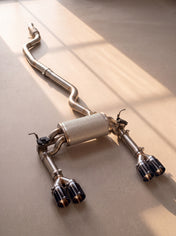
Valved Exhaust System for BMW 335i F30 / F31 3.0T (2012-2015)
From $2,780 · 3-year warranty
Configure my exhaustA question about your 335i F30 or F31?
Put it to the Rog Advisor or write to us: we reply in writing, within 24 hours.
Further reading.
Read next
- Mercedes-AMG E55 W211 / S211 V8 Kompressor: the wolf in a business suit, the exhaust guide Mercedes-Benz E 55 AMG W211 or S211 wagon: for this E-Class with a supercharged V8, we recommend a...
- Mercedes-AMG CLS53 C257: the return of the straight-six, the exhaust system guide A four-door coupé with flowing lines, the CLS53 C257 benefits from Mercedes' return to a layout the brand...
- Toyota GR Supra A90 L6: the B58 takes center stage, the exhaust system guide The GR Supra A90 revived a legendary line by pairing a short rear-wheel-drive chassis with the B58 3.0-liter...